Category Archives: forecasting

Saturn Chasing the Moon

How can we forecast long-term trends with astrology? I wondered what took my grandmother away from her home in the U.S. for nine years during World War II. She had lengthy transits of Pluto and Neptune through houses, but their aspects changed and didn’t seem the most descriptive of her situation. Her progressed Sun in Sagittarius in her 4th house would show the developments in her home situation, including foreign travel, but that’s a longer trend. She also had Saturn chasing her Moon.
Since the progressed Moon’s cycle through the signs and Saturn’s transit cycle are similar (around 28 or 29 years), some of us will experience extended periods of time with Saturn repeating the same aspect to the progressed Moon. This, too, is such a long-term influence that it may be tough to categorize.

Saturn opposed my progressed Moon for over 20 years. For me, the period coincided with career development, important decisions, a lot of hard work and important housing issues. I also researched my family genealogy, broke an ankle and had minor surgery. I lost my father and became a caretaker for my mom. The symbolism is clear, but these are also typical life events that many of us will experience in a 20-year period.

My grandmother Ida’s cycle started in 1935 with Saturn in her 7th house opposite the progressed Moon in the 1st, and didn’t end until after 1948, with Saturn in the 1st and the Moon in her 7th (lasting about 13 years, nearly half a Saturn cycle).
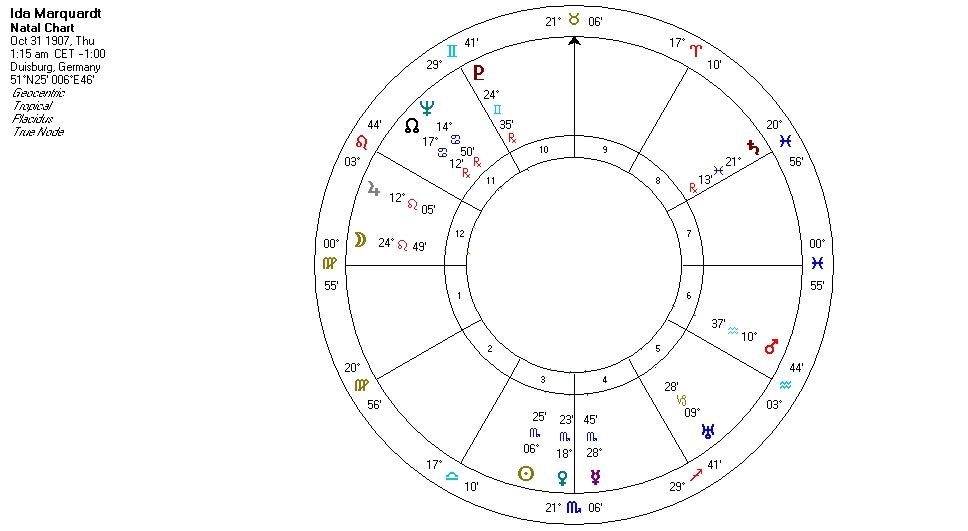
Ida’s natal Moon was in the 12th and Saturn in Pisces in her 8th house. Both might relate to events she couldn’t control. There’s no close connection between the two planets, but they’re widely inconjunct (over 3-1/2 degrees apart), not the most comfortable aspect.

Ida had been away from her native land and family members for about six years when her progressed Moon began to oppose transiting Saturn. She never gave us convincing reasons why she didn’t come back to New York before her visa expired. Though when back in Germany, her mother wasn’t well and she also had no great affection for her husband in the U.S. She worked on the family farm and later had jobs as a mail carrier, waitress and housekeeper. World War II brought major limitations: food shortages and life-threatening situations. Her mother and two brothers died during this time. Ida finally got back to New York in 1947, but a year later her husband had a stroke and died, leaving her with little money and an infant to raise. The final two exact passes of her progressed Moon to transiting Saturn came later that year.

Most people won’t experience dire events like these. And because of its length, the transit Saturn-progressed Moon cycle is somewhat unwieldy for astrologers to interpret. It nests within many other cycles and we need to do a lot more research to understand how best to describe it.

See my previous post for more information on Ida’s natal chart and her experiences as a refugee and displaced person.
McWhirter’s Market Forecasting Techniques

Louise McWhirter’s 1938 book on stock market forecasting outlines the methods she used to predict long and shorter-term trends on the stock market. She had obviously studied both natal and mundane astrology and used the North Node’s cycle, her own rectified chart for the New York Stock Exchange, the horoscopes of corporations, and lunations and transits to form her judgments.

The North Node’s cycle outlined the bigger swings of the market. From Scorpio to Libra, expected business volume moves from normal to above normal, creating prosperity. In Leo, business is at a high point. In Cancer and Gemini, business is above normal trending toward normal. With the Node in Taurus through Aries, we transition to below normal. When the North Node passes into Aquarius, we are at the low point. From Capricorn to Sagittarius we move from below normal to normal again.

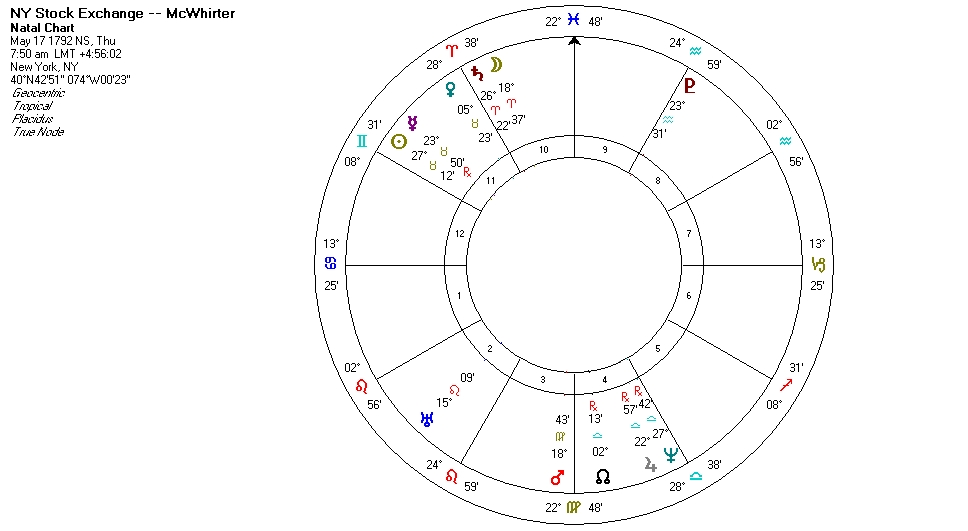
McWhirter rectified the NY Stock Exchange chart, giving it a 14 Cancer Ascendant with 24-1/2 Pisces on the MC and felt that transits to the angles would change the trends in securities, bonds and the general condition of the market. These “secondary factors” could alter the expected nodal cycle movement by up to 20%. Lunations (New Moon charts) compared with the NYSE horoscope will show the trend of the coming month.

Other factors can also throw this business cycle out of its expected rhythm. Transiting Jupiter conjunct the Node or in favorable aspects to Saturn or Uranus may give the markets a boost. Saturn or Uranus in hard aspect to the Nodes should depress prices. The positive or negative aspects between transiting Saturn and Uranus can also be used to forecast major trends. Louise felt that both the signs of Gemini and Cancer related to the United States, so Jupiter in these signs was helpful, while Saturn, Uranus and Pluto here were not.

To forecast for individual stocks, McWhirter utilized incorporation dates and their solar charts. If their natal planets connect to the NYSE chart, we can expect them to follow the general market’s trend. Lunations and outer planet transits to these charts will indicate how the particular company will fare in the coming months and years.

In 1938, McWhirter reiterated Dr. Luke D. Broughton and Evangeline Adams’ cycle for U.S. war with Uranus in Gemini, and correctly forecast that when Saturn and Uranus were in this sign from 1942 to 1944, it suggested “war, depression, government change, social upheaval and a financial panic.”

Louise McWhirter’s methods might not be as effective today as they once were, but they’re based on sound, standard astrology. We can all begin to test them by following the charts for the market and individual companies and studying the transits and lunations to them. As Louise advised, “It takes time and practice to become adept in analyzing the charts of stocks, but it is interesting and very worthwhile because it helps you to obtain financial independence through investment of a sound and practical nature.”

My biographical sketch of Louise McWhirter is here.

McWhirter Theory of Stock Market Forecasting is on Amazon.

Louise McWhirter

Search the web and you’ll find plenty of information on financial astrologer Louise McWhirter, though all of it relates to her 1938 book, McWhirter Theory of Stock Market Forecasting. Her low profile has even led some to speculate she was only a pseudonym for W.D. Gann (a rather sexist theory proposed by a man). But yes, she did exist.

Wikipedia shares information from a family member’s posts on Ancestry.com. Martha Louise McWhirter was born in 1896 in New York City, and we can find additional family information in Census records. Her younger brother was born two years later. Her father, Robert, was from Texas and her mother was from France. By the time Louise was 14, she was living in Maryland, her father had remarried and he was now a gardener and shareholder in a cooperative farm, which must’ve been an unusual situation at that time.

Louise’s parents had divorced and her mother returned to New York, working as a department store clerk. She died when Louise was only 21 years old.

McWhirter married John Mitchell Henry soon after, and the couple settled in Bayonne, New Jersey. They eventually owned their home and had five children – making it obvious why Louise didn’t publish her book until her early 40s. John worked as an assistant engineer at an oil refinery and Louise was a stay-at-home mom. Apparently she used her middle and maiden names for her work for privacy. She had studied the astrology of financial markets for years and one would guess that she made some modest investments herself. Perhaps she did readings for clients.

Evangeline Adams and her teacher Catherine Thompson had used some financial forecasting techniques beginning in the late 1900s. The stock market crash of 1929 brought more interest in predicting the highs and lows of the market. Sepharial and L. Krohn had written a few books on the subject in the ‘teens, W.D. Gann was also writing by that time, and James Mars Langham and L.J. Jensen had published financial astrology texts in the early ‘30s. McWhirter says she originated the New York Stock Exchange chart, and Graham Bates credits her with rectifying it.

We don’t know exactly who Louise’s astrology teachers were. Her home was within commuting distance from Manhattan, where she might have taken classes with one of Evangeline’s former employees like Iris Vorel, Myra Kingsley, Nella Webb or Lynn Wells. Other New York astrologers at the time included Elizabeth Aldrich and Katherine Taylor Craig. Astrologer Juliet Pontin had a home in New Jersey and an office in the city.

McWhirter used the North Nodal cycle, transits and lunations to the NYSE and incorporation charts for long and shorter-term forecasting. She was a Libra with Jupiter in Virgo and her book is a clear and workable instruction manual on how she used astrology to forecast the ups and downs of the markets. As she said, “It is no longer necessary to be wiped out on the Stock Market. That is a sign of ignorance.”

I’ll share more about her book and forecasting methods in a later post.

McWhirter Theory of Stock Market Forecasting is on Amazon.

Jane Austen… Again

Over 200 years after her death, Jane Austen’s popularity continues to soar. Her numerous book spin-offs include plays, film adaptations, soft-core porn sequels and even things like Pride and Prejudice and Zombies. With Neptune rising in her horoscope, it appears that everyone can see something different in Austen.

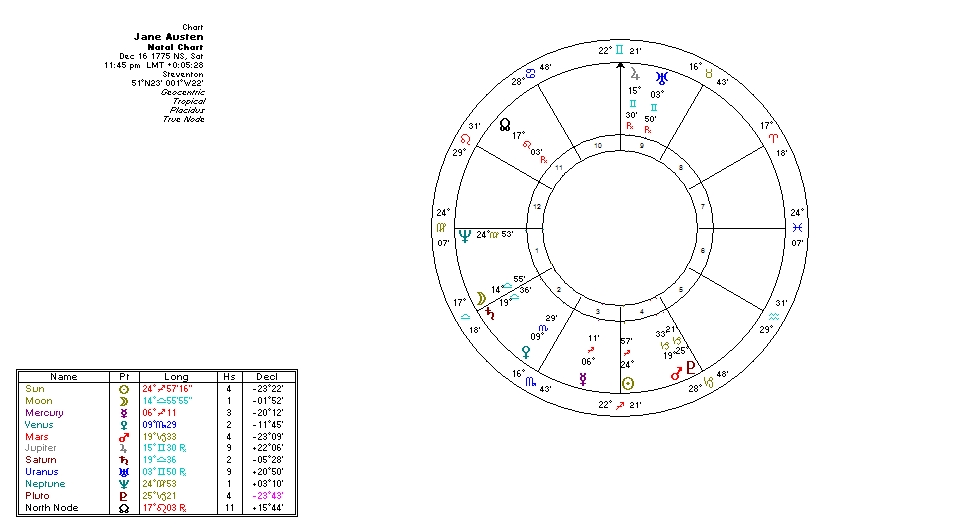
Neptune conjoining the Ascendant in Virgo in Jane’s chart makes her work multi-layered. Her books give us her personal impressions and are true-to-life reflections of daily concerns that strike a chord with readers, perhaps because there is usually some romanticism and often the suggestion of happy endings. But typical of Neptune, we don’t even know what she looked like!

Austen may not always be what she appears, especially as Neptune squares her 4th house Sun in Sagittarius. Commentators have seen her as a conservative, a house-mouse and a feminist (she never married and while tied to her family, she produced great novels). Her Mercury in Sag. in the 3rd attests to her need to write, and it opposes Uranus in the 9th house, giving her an independent outlook. Jupiter in Gemini in the 9th shows her education and the ability to publish, especially as it trines her Moon and Saturn straddling the 2nd house cusp. This aspect is probably part of what has continued to keep her books popular with readers, as Saturn can bring longevity. (While she sold some work during her lifetime, Jane did not make much money at it.) Venus in Scorpio indicates her deep feelings.

The Moon in Libra conjoining Saturn gives Austen a consistent interest in relationships, which were both persistent (especially those with women) and limited (she quickly broke off an engagement). The Moon and Saturn also square Mars in Capricorn in her 4th house, suggesting responsibilities and obligations to the home and family. Her life had limitations. Saturn squaring Pluto in Capricorn shows her pragmatic and realistic side. The Sag. and Capricorn planets combine to make her work both humorous and ironic.

With Pluto trining the writer’s Ascendant in 2020 and returning to its natal place in 2021, the recycling of her brand will probably continue. Hopefully some of it will get to the heart of what makes Jane Austen special.

Jane Austen was born on December 3, 1775 at around 11:45 pm in Steventon, Hampshire, England, according to a letter from her father – see Astrodatabank.
Helena Kelly’s feminist analysis, Jane Austen, Secret Radical, deconstructs Austen’s life and work and provides an encyclopedic look at the history and culture of the time.

Astrology to the Rescue!

It’s such a common movie and TV plot: a person is at a crossroads and they don’t know what to do. Should they marry X? Go to school? Change jobs? There’s a lot of drama before the protagonist makes the right (or wrong!) decision. It often leaves me thinking that, if they’d just go to an astrologer, things would be a lot easier.

Astrology can answer so many questions of life, perhaps especially those related to the angular houses of self-expression, relationships, career, home and family. A horoscope is like a map or compass showing your life’s pattern. While it can’t provide specifics, it can often tell us more about all of the following:

The areas of life and types of experiences that should come easily to us;
Where challenges could occur, with suggestions to overcome them;
How to best develop your talents;
What to expect from partners, superiors, lovers and friends;
How uncontrollable events may impact on you and how to best address them (things from the outside world, culture or society);
Where your greatest opportunities could appear and when to expect them;
If it’s better to get married now, later or never;
How to maximize your assets;
How to overcome your liabilities;
The types of career that you could succeed in and what to expect along the way;
If a problem is temporary or long-term, when and how it may be resolved;

And much more! In fact, for every area of life, there’s probably an astrologer who can give you more insight.

Foreseeing the Future Update

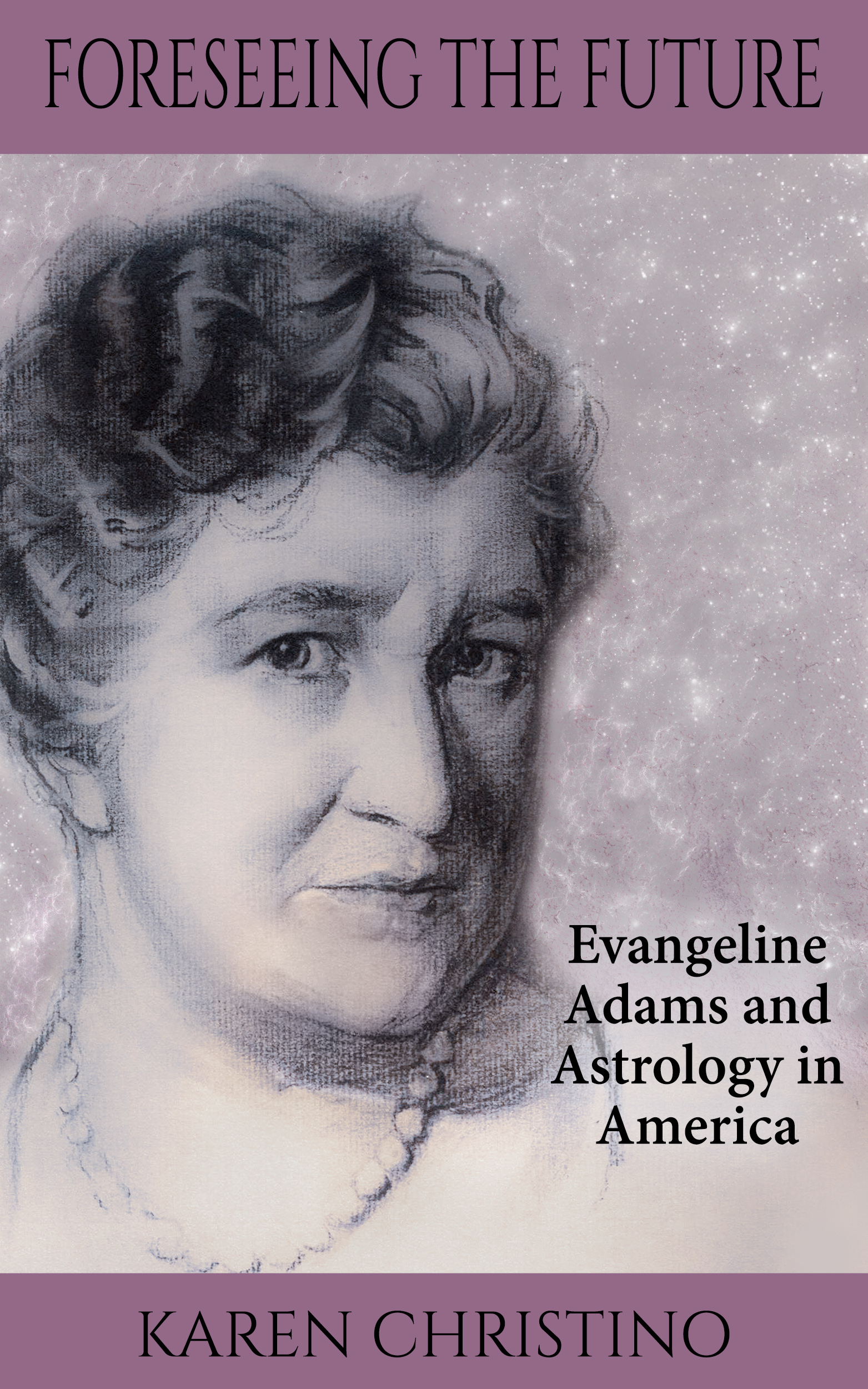
I’ve just finished the update of my biography of the famous American astrologer Evangeline Adams, Foreseeing the Future. The original was published in 2002, and with more information from newspaper databases and genealogy websites online, I’ve now filled in details on the people in Adams’ life and included more historical context.

I’ve found additional information confirming Evangeline’s forecasts and I also take a look at her sexuality, but basically it’s the same story. There are so many public domain photos now available online so I included a lot more pictures, too.

My main focus in this book has always been to document Adams’ forecasts and provide an objective look at what astrology can do, while also telling her life story. I leave it to readers to make up their own minds. I’m dismayed to see that Wikipedia’s entry on Adams has been edited in recent years. References to any of Evangeline’s substantiated forecasts have been removed. Any mention of my book has been deleted, replaced by skeptics’ opinions, tertiary and inaccurate sources, with no documentary evidence to support any statements made, despite supposed notes and references. I have no appetite to fight them, and hope the book continues to help people better understand how astrology and astrological forecasting work.

Updated print and digital versions are now available. Many thanks, as always, to Bruce Scofield and One Reed Publications for publishing the original.

For more on the book see my webpage.

To order the updated Foreseeing the Future for Kindle, click here. Or order the updated print version on Amazon.com.

Stacey Abrams and Recounts

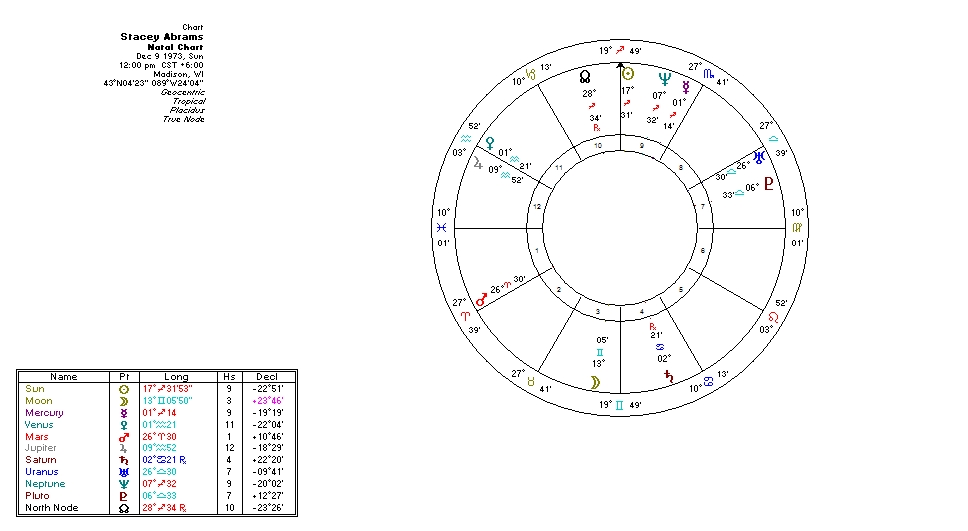
Stacey Abrams has been battling entrenched authorities in the Georgia Governor’s race as transit Saturn creates a T-square with her natal Saturn-Pluto square. She’s won a court victory as a judge authorized votes with partial discrepancies. Tr. Saturn will exactly square her Pluto on 11/18/18, the time when the Florida Secretary of State could certify the election. It’s disappointing that we have no birth time, as it seems to me there’s some progressed angularity we’re missing with the noon chart I used.

Abrams is an eclipse person, with a partial lunar eclipse the day after her birthday. She also has a probable Out of Bounds Moon that also attracts attention. She’s a lightning rod and literally the opposite of Donald Trump with her Sun in Sagittarius and Moon in Gemini.

Her progressed Sun, Moon (depending on birth time), Mercury, Venus and Jupiter are all in Aquarius, accentuating Abrams’ Moon-Venus-Jupiter-Pluto grand air trine. Transit Uranus stations near her Mars in Aries from late December to early January 2019, when it will exactly trine her North Node in Sagittarius. Jupiter will also conjoin her Sun in January. While the Governor’s race is hard to call without a birth time, Abrams has gained national recognition and should begin a major new adventure in 2019.

The Moment of Astrology

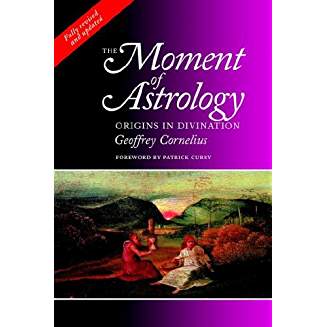
Geoffrey Cornelius has taken a wonderful look at astrology and skepticism and concludes that horary is a tool for divination in The Moment of Astrology. While somewhat philosophical, this well-researched book is also full of gems from the history and practice of astrology.

Scientific studies of astrology often don’t work, and the author feels that our reliance on quantification “threatens to undermine the whole way of proceeding with symbols.” He shares an often overlooked conclusion by Jung in his analysis of married couples, that the attitudes and desires of the person doing the research will influence the result (kind of a quantum theory point of view).

We’re treated to a survey of the history of astrology, from predestination to inclination and more mystical approaches. He sees his own perspective as originating in Mesopotamian, Greek and Roman models of divination, which necessitated a participatory relationship between the gods and humans. He also addresses the odd circumstance that many practicing astrologers experience, of getting the right answer from the wrong chart.

Geoffrey Cornelius sees horary or electional astrology as seeking a blessing, and that the outcome is not compelled. There is an allegory between planets and events. In his own work, Cornelius tries to answer the question of how to resolve the situation “to the good fortune” by presenting the client with possibilities. He reminds us of Lilly’s admonition to “afflict not the miserable with the terror of a harsh judgment.”

There are few actual horary charts included, but the interpretations are fascinating. Geoffrey analyzes the horoscope presented with the 1975 Humanist article (where scientists attacked astrology), Charles Carter’s query about horary itself, and perhaps most compelling, his own horary about an exploitative tenant of his aunt’s. These make terrific studies.

The horary revival is seen as beginning with Olivia Barclay’s reprint of William Lilly and Derek Appleby’s book, both in 1985. This surprised me, but I was reminded that in the U.S., Ivy Goldstein-Jacobson’s horary book came out in 1960 and Barbara Watters’ in 1975, so the American revival was actually earlier.

The Moment of Astrology is an in-depth, thorough and thoughtful work. I took my time reading it as there is much to consider and it can be slow going at times. I can’t agree with all of Geoffrey Cornelius’ conclusions, but he is always thought provoking.

Buy The Moment of Astrology on Amazon.com.

Edgar Cayce Brought Me to Astrology

The hair! The eyebrows! This is a picture of me and my mom, Renee, around the time I started studying astrology in the 70s.

My new astrology column is out in Venture Inward magazine. I write about how Renee (and then I) became interested in astrology through an Edgar Cayce study group.

You can download a sample issue of Venture Inward (current ones are available through membership). If you’re interested in psychic phenomenon, mind-body-spirit, reincarnation, ancient civilizations, dreams and meditation, you may want to check it out.

Here’s the start of the column:
“In 1968, my mother, Renée, at age 37, had three children and owned a home in the suburbs. But she was unhappy. My dad commuted to work every day and the kids were all in grade school. Renée was not one to socialize with neighbors and she felt alienated from her Church. She often thought she was “weird” because she wasn’t attracted to the things others enjoyed. And hadn’t life promised something more? She was experiencing a notable transit of Saturn, which may make us feel dejected or uninspired. Cayce often suggested it brought change.”

Astrology helped both of us! And it still does.

Uranus in Taurus and Fascism

Astrologers have noted the link between Uranus in Taurus (April 1935 to April 1942) and Fascism, which coincided with Hitler, Mussolini and Stalin’s authoritarian regimes. Madeleine Albright’s book Fascism: A Warning provides insight into this period of history.

Early on, the author shares the odd coincidence that Charlie Chaplin and Adolf Hitler were born only four days apart, quoting a line from Chaplin’s The Great Dictator (1940): “You are not machines! You are not cattle!” which literally underscores themes related to Uranus in Taurus.

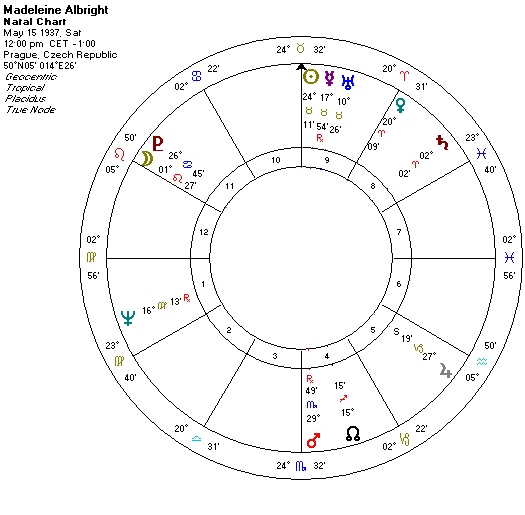
The former Secretary of State turned history professor is a Nazi refugee who speaks from her own personal experience. I found it refreshing to hear her sensible arguments and deep understanding of the scope of history. Albright has Mercury retrograde widely conjunct Uranus in Taurus and trine Neptune in Virgo (no birth time available). She’s approaching her Uranus return.

Albright quotes Hitler as attributing his own popularity to his ability to reduce issues to their simplest terms so people would easily accept them. It appears that the potential danger of Uranus in Taurus lies in strong, ideological convictions. Based upon world history, fixating on the wide-scale acquisition of land and property may also reflect this symbolism.

Madeleine Albright defines Fascism as an extreme authoritarianism linked to nationalism, the lack of concern for the rights of others, and leaders taking whatever means necessary to achieve their goals. Through optimism and traditional views, Fascists typically generate hope for political change. Their unwavering trust in their own judgment attracts followers who see them as decisive, and they may accomplish some things early on.

Fascists often take control through legitimate means but soon dismantle democratic systems. They despise reasoned debate, take steps to thwart the freedom of the press and an independent judiciary, and divide by striking out at enemies both within and outside of their own parties. Fascists typically admire other authoritarian leaders and seek to emulate them. At the end of the book, Albright adds that, “the herd mentality is powerful in international affairs.” In the 20th century, “steamroller” effects were not recognized until it was too late.

Uranus in Taurus may have firm but simplistic views and could also be insensitive (Albright uses the term “moral numbness”). Though it can initiate radical change, it does suggest monomaniacal systems and self-serving principles rather than democratic ideals.

Buy the book at Amazon.com — Fascism: A Warning