Robert Zoller

Robert Zoller was an unforgettable character. Despite his focus on Medieval astrology, I always thought of him as a Renaissance man. He liked to call himself a “rogue scholar,” but was also a linguist, dowser, sketch artist and high-wire telephone electrician, as well as a man of extremes. Mild-mannered and modest, he could also be rather opinionated and even imperious (he claimed descent from Irish royalty). Outwardly a regular guy with a light New York accent, his work could be overly intellectual (consider a lecture entitled, “The Role of Hermes as Teacher, Initiator, Heirophant and Psychopomp”). A predictive astrologer, he probably leaned closer to the Fate side of the spectrum than many, yet as an adult he became a Lutheran (a Christian faith with an ideology based on Free Will).

Bob was a footloose vagabond who loved travel and could casually converse in Spanish with NYC waiters. A compelling speaker, his fame in the 1990s followed his translations of Hermes Trismegistus, Al Kindi and Guido Bonatti, and he sometimes lectured to standing-room-only crowds. He may be best remembered for his World Trade Center attack forecast, and while not hitting all the specifics (who could?), it was published in advance and sent to his subscription list in 1999 and 2000.

With no earth in his horoscope, Zoller was not very concerned about the material plane (something he probably thought an “infinite regress”). He lived simply and delved deeply into magic, meditation and spirituality. He argued that “Spirituality is a Saturn trip,” as he considered it involved more renunciation than Jupiterian expansion. He believed in angels and other beings not because the Bible told him so, but because he had experienced them first-hand.

While I had little use for the laborious Medieval astrological calculations he was attached to, I visited the Masonic Library in New York at his request, and accompanied him to W.D. Gann’s grave in Brooklyn (which I’m convinced he psychically found as we had little in the way of a map for guidance). He gave me the opportunity to turn the parchment pages of a 15th century Latin manuscript at the New York Public Library.

Bob’s outlook lay somewhere between radical libertarian and ultraconservative, but it would be wrong to categorize him. He shared subversive 1970s counter-culture classics. He didn’t vote as he felt that election results were pre-ordained. He’d calculate death dates on request from clients (to within 5 or 10 years), though he also felt that in astrological prediction, “If you’re getting 75%, you’re doing really well.” He scoffed at the ideas of evolution or alien UFOs. He suggested he was the reincarnation of Evangeline Adams, as they shared some similar horoscope placements and more than a passing physical resemblance. But as he relished both the profundity of life as well its absurdities, I was never certain whether or not he was joking.

With a consciousness always attuned to the cosmos, I trust that Bob Zoller is now off on another one of his audacious adventures.

Robert Zoller had a number of self-published books, though his one traditionally published title, the Arabic Parts in Astrology: A Lost Key to Prediction is still available at Amazon.com.

About my Amazon links.

Novel About Astrologer

Astrology is back in the mainstream and has been for a while. Astrologer Barbara Shafferman recommended a book that she discovered by chance – it just happened to be about an astrologer – 2009’s literary and mystery novel Drive Your Plow Over the Bones of the Dead by Nobel Prize winner Olga Tokarczuk. It’s a good read that says something about the contemporary human condition.

Janina, our protagonist and narrator, is a retired teacher living in rural Poland. She has a passion for studying astrology and helping a student translate William Blake’s letters. A vegetarian, she tries to live simply and shares great empathy with animals. But she suffers from debilitating health attacks and nightmares about her dead mother, while also finding herself in the midst of a series of local murders.

The book is part detective story and part psychological study: we get to know this marginalized woman living in an unbalanced, harsh environment. Her frustrations in dealing with the corrupt, ineffectual and even violent local authorities are very relatable since her age and unconventional beliefs make her someone who’s not taken seriously.

Janina admits she’s not a good astrologer, and maybe she’s not, as she puts small animals in the 3rd house. It’s hard to know whether the use of words like quadrature (for square) or cosmogram (for horoscope) were a translator’s lack of expertise or a choice to make Janina seem quaint (she also talks of using a slide rule for calculations). Does knowing her date of death support that the character is unrealistic or show the writer’s limitations on the subject?

Janina has some lovely thoughts about her place in the universe:
“The world is a great big net, it is a whole, where no single thing exists separately, every scrap of the world, every last tiny piece, is bound up with the rest by a complex cosmos of correspondences, hard for the ordinary mind to penetrate.”

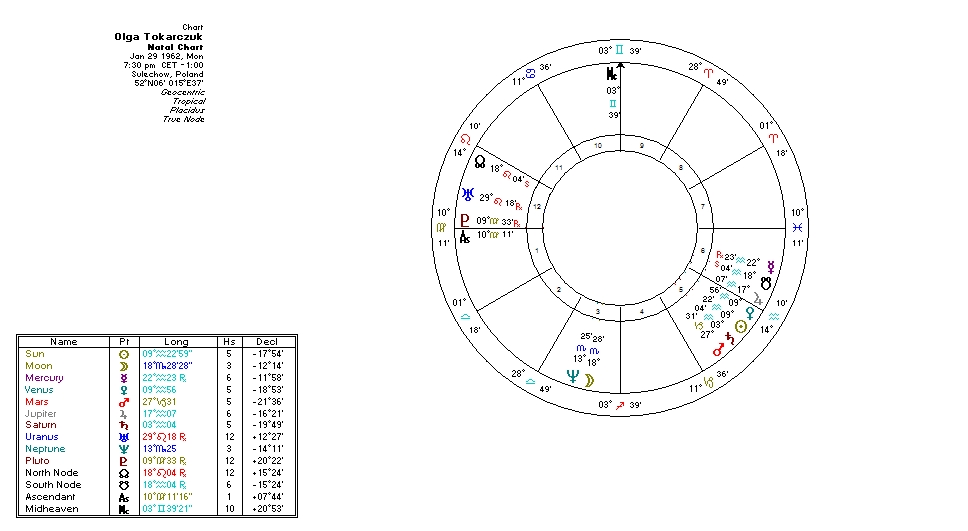
Tokarczuk clearly knows astrology herself as she refers to it throughout the text; she worked as a Jungian therapist before her writing career. Born on January 29, 1962 in Sulechrow, Poland, she has the Sun, Mercury, Venus, Jupiter and Saturn all in Aquarius – no surprise for someone attracted to astrology!

I won’t reveal the ending, but I found Drive Your Plow engrossing, with a skillfully balanced plot and the extra bonus of following a real character whose astrology – for better or worse – is part of the tapestry of her life.

Buy Drive Your Plow Over the Bones of the Dead on Amazon.com
About my Amazon links

Dell Horoscope Review

I was delighted to read Chris Lorenz’ review of my book about Evangeline Adams in the Dell Horoscope 2020 Yearbook!

He writes, “In this deeply researched and fascinating biography, readers can follow the evolution of astrology… as experienced and shaped by Evangeline Adams… Thank you, Karen Christino, for bringing us her story.”

Sorry to see this magazine leave us. It’s come full circle for me, as Horoscope was the first mainstream publication to publish my work.

More about the book here.

Jupiter in Capricorn

Jupiter in Capricorn is traditionally in its “fall” – since Jupiter wants everything big and upbeat, and Capricorn likes things simple and realistic. It’s a bit of a conundrum to have the planet of expansion in the sign of contraction and restriction. But obviously some make it work! These people may not find lucky breaks as often as those with Jupiter in more compatible signs, but those with Jupiter in Capricorn often achieve positions through genuine hard work and earnest application to their goals. Their careers can be long-lasting, and we remember many of them well after they’ve passed.

Some become quite accomplished at what they do, and find a commitment to their work. Jupiter rules the higher mind and ideals, and the sign of Capricorn makes them pragmatic realists. Many are self-contained and low-key, not flashy.

Government Boosters
Jupiter and Capricorn share an interest in larger issues, which can include the government. So it’s no surprise to see many with this placement in positions of authority. They often conduct themselves with Capricornian decorum:
Elena Kagan, Amy Klobuchar, Beto O’Rourke, Barbara Bush, Gerald Ford, Margaret Thatcher, Madeline Albright.

Memorable Classics
Jupiter’s need for self-expression meets Capricorn’s ability to be succinct and pithy. These examples show how memorable Jupiter in Capricorn can be:
Langston Hughes, Emily Dickinson, Elizabeth Barrett Browning, Emily Bronte.

Authentic Voices
Jupiter in Capricorn may also bless many with the ability to accomplish their goals – no matter what area of life Jupiter chooses to expand to. These individuals can have a deeply personal connection with their ideals, along with a Capricornian authenticity, sharing with others who they really are, perhaps based on hard-won personal experience:
Alyssa Milano, Pope Francis, George Takei, Caitlyn Jenner, Prince Harry, RuPaul, Edgar Cayce, Malcolm X, Vanessa Redgrave.

Astrologers
Astrologers can also be Jupiterian idealists with an interest in Capricornian timing. Based upon the number of astrologers with this combination, it seems a common one:
Linda Goodman, Noel Tyl, Steven Forrest, Marion Mayer Drew, Kim Farnell, Cheiro – and many more.

Inspired Careerists

The folks that follow may not seem like typical Capricornians – somehow the emphasis is on an expansive Jupiter. But they also have long-lived careers and continue working – not satisfied with being a “flash in the pan.”
Tilda Swinton, Courtney Vance, Miley Cyrus, Marie Kondo, Mark Zuckerberg, k.d. lang, Katy Perry, Dwayne Johnson, Lorde.

Humorists
Another commonality between this planet and sign is comedy. It can bestow a dry sense of humor, good timing or an appreciation of irony. Those who have it also seem to be down-to-earth and grounded:
Scarlett Johansson, Julia Louis-Dreyfus, Gwynyth Paltrow, Sofia Vergara, Kathy Griffin, Valerie Bertinelli, Mary Tyler Moore.

Questionable Ethics

There’s a down-side to every astrological combination, and we might say that those with Jupiter in Capricorn can go too far or be too ambitious, insensitive to others in pursuit of their goals, or even become autocrats. With Saturn ruling Capricorn, however, they may ultimately pay the price for their bad behavior:
Benjamin Netanyahu, Paul Manafort, Linda Tripp, Michael Flynn, Bill Cosby, Dustin Hoffman, Saddam Hussein, Richard Nixon.

Planetary Powers

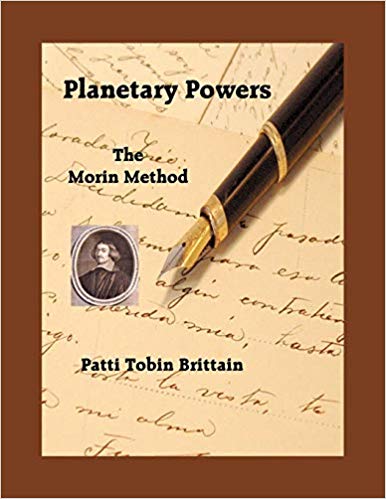
Patti Tobin Brittain’s book, Planetary Powers: The Morin Method takes the reader through the first steps in understanding how her teacher, Gerhard Houwing and his accomplished source, Jean-Baptiste Morin (1583–1656), may have interpreted a horoscope. As I have a background in this method myself, it was fascinating to see her approach.

This is a clear introductory text that focuses on what the author calls “cause and effect.” Brittain uses stripped-down charts with only a few key elements to show how the ruler of one house placed in another creates meaning. She provides numerous examples to familiarize the reader with these mechanics, almost like drills. They are often illuminating, but it can be unclear whether the examples represent real people or theory.

Another important concept is “analogy.” The Sun has an affinity for the 10th house, and Venus for the 7th, for example. These will vary by sign, ruler, house or aspect and are also clearly illustrated. This is another concept that I had personally absorbed but never reviewed in such detail.

The planets’ essential nature (their basic meanings and whether malefic or benefic) are significant, as is cosmic state (dignities and debilities). Morin used simplified triplicity rulers (different than those in Ptolemy or William Lilly).

Students interested in Morin’s methods should find this book a good, accessible starting point. Houwing emphasized “the concise, the specific, the concrete” and a “systematic approach to reading a chart.” These do reflect Morin’s traditional practices, which are very different from modern psychological astrology.

Houwing “felt it was worse to be unresolute than to be wrong” and Brittain admits this “may sound fatalistic.” I found it so myself when one of her “malefic” examples reflected components of my own chart! I personally strive to be accurate in a more general way than rigorously specific, as the latter can often be misleading, judgmental, or just plain wrong. Horoscopes, like human beings, are complex.

Some intriguing tidbits are mentioned but not addressed and are certainly beyond the scope of the book. But I would’ve liked to read more about what factors could indicate events in childhood, middle or late life, or what placements might show experiences that are fleeting vs. constant and ongoing, for example.

Patti Tobin Brittain died in March of 2019 at the age of 91. Born on 10/28/27 in Forney, Texas, she had the Sun, Moon, Mercury and Mars all in Scorpio in a grand trine with Jupiter in Pisces and Pluto. Her mentor Houwing was born on 10/27/23 – just a day and four years before Brittain, so we can understand their connection astrologically. They share the Sun and Venus in Scorpio and both appear to have been single-minded and incisive. Houwing’s Jupiter closely conjoins Brittain’s Mercury, and he passed along his knowledge and experience to her. But while the teacher had Mercury sextile Neptune, the student had a square between these planets, so something may have been lost in this rendition of Houwing and Morin’s work.

Taking apart a horoscope to understand its working parts may be valuable, but putting an emphasis on isolated elements makes for a somewhat linear and literal approach. Another book is needed to fill in the vast spaces between the simplified examples shown and an interpretation and synthesis of the full horoscopes presented at the end of the book. Nevertheless, Planetary Powers provides a valuable introduction to Morin’s methods.

Check out Planetary Powers (AFA, 2010) on Amazon.com
(About my Amazon links)

Brittain’s birth date is from her obituary.

Houwing’s birth date is from public records on Ancestry.com

Mundane Astrology

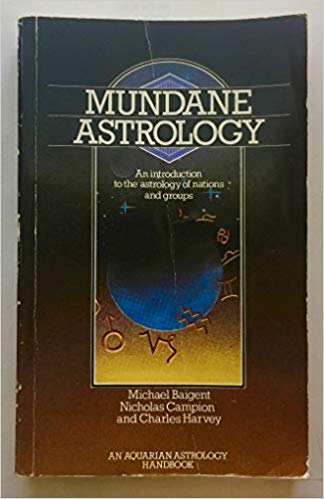
The comprehensive astrological textbook Mundane Astrology: an Introduction to the Astrology of Nations and Groups (1984) benefits from the contributions of three accomplished astrological authors – Michael Biagent, Nicholas Campion and Charles Harvey – who raised the level of astrological discourse with their contributions. While readers need a familiarity with basic astrology to understand this book, those interested in the subject, whatever their level of knowledge, will find much valuable information.

This is one of the excellent astrology books published by the U.K. based Aquarian Press in the 1980s. It begins with a concise history of western mundane astrology dating back to the Babylonians. Basic meanings of planets, houses and signs in mundane astrology are provided, along with information on various planetary cycles. Other topics include ingress charts, lunations, eclipses, Astrocartography, the astrology of cities and countries and much more. This book predates Biagent’s Astrology in Ancient Mesopotamia and Campion’s Book of World Horoscopes and The Great Year, and provides an introduction to those works. I had never read Charles Harvey before, and his discussion of planetary cycles is phenomenal, including many references to Andre Barbault’s work. He also addresses midpoints, giving us a better understanding of this topic, too. The work of Charles Carter and John Addey is also covered, and with numerous references to the works of others, the book serves as a resource for more.

A long section pulls the techniques together to analyze World War II, as many European astrologers failed to accurately forecast it (ironically, Americans Elizabeth Aldrich, Louise McWhirter and Evangeline Adams had all predicted U.S. involvement in a conflict years earlier).

While this is a long book, many chapters are inclusive in themselves. The Table of Contents and Index make it easy to find topics of interest.

And it’s time for a reprint! While the book is available second-hand, copies tend to be rather expensive. The charts are small and hand-written, and can be challenging to read. Planetary abbreviations at times also make for a less than fluent read (it took me a while to find the key and realize that SO stood for the Sun!). Notes and sources sometimes follow one chapter and other times are placed further along in the text. The use of a 90-degree dial around the outside of many of Harvey’s charts is not explained until the very end, and it would’ve been more helpful at the beginning. A tiny font detracts from the Index. (Perhaps the 1995 Thorson’s edition may have resolved some of these issues.)

But these are quibbles. Mundane Astrology is a classic of astrological writing, superbly researched and clearly written. The authors generously share their abundant knowledge, and anyone interested in this complex subject will profit from reading it.

Check out Mundane Astrology on Amazon.com

Astrology News Service Review!

I was thrilled to see Armand Diaz’ review of my book, Foreseeing the Future: Evangeline Adams and Astrology in America on Astrology News Service. He says,

“Adams was not only a good astrologer, as Karen Christino’s book clearly shows. She was a real maverick in many ways, including her fight to establish herself in business at a time when women rarely held positions of authority. She was also a master of self-promotion, and one gets the impression that Adams possessed the abilities of a great mystic in liberal combination with the spirit of P.T. Barnum.”

For more on the book and links to order, click here.

Saturn Chasing the Moon

How can we forecast long-term trends with astrology? I wondered what took my grandmother away from her home in the U.S. for nine years during World War II. She had lengthy transits of Pluto and Neptune through houses, but their aspects changed and didn’t seem the most descriptive of her situation. Her progressed Sun in Sagittarius in her 4th house would show the developments in her home situation, including foreign travel, but that’s a longer trend. She also had Saturn chasing her Moon.

Since the progressed Moon’s cycle through the signs and Saturn’s transit cycle are similar (around 28 or 29 years), some of us will experience extended periods of time with Saturn repeating the same aspect to the progressed Moon. This, too, is such a long-term influence that it may be tough to categorize.

Saturn opposed my progressed Moon for over 20 years. For me, the period coincided with career development, important decisions, a lot of hard work and important housing issues. I also researched my family genealogy, broke an ankle and had minor surgery. I lost my father and became a caretaker for my mom. The symbolism is clear, but these are also typical life events that many of us will experience in a 20-year period.

My grandmother Ida’s cycle started in 1935 with Saturn in her 7th house opposite the progressed Moon in the 1st, and didn’t end until after 1948, with Saturn in the 1st and the Moon in her 7th (lasting about 13 years, nearly half a Saturn cycle).

Ida’s natal Moon was in the 12th and Saturn in Pisces in her 8th house. Both might relate to events she couldn’t control. There’s no close connection between the two planets, but they’re widely inconjunct (over 3-1/2 degrees apart), not the most comfortable aspect.

Ida had been away from her native land and family members for about six years when her progressed Moon began to oppose transiting Saturn. She never gave us convincing reasons why she didn’t come back to New York before her visa expired. Though when back in Germany, her mother wasn’t well and she also had no great affection for her husband in the U.S. She worked on the family farm and later had jobs as a mail carrier, waitress and housekeeper. World War II brought major limitations: food shortages and life-threatening situations. Her mother and two brothers died during this time. Ida finally got back to New York in 1947, but a year later her husband had a stroke and died, leaving her with little money and an infant to raise. The final two exact passes of her progressed Moon to transiting Saturn came later that year.

Most people won’t experience dire events like these. And because of its length, the transit Saturn-progressed Moon cycle is somewhat unwieldy for astrologers to interpret. It nests within many other cycles and we need to do a lot more research to understand how best to describe it.

See my previous post for more information on Ida’s natal chart and her experiences as a refugee and displaced person.

A Refugee

What do immigrants and refugees have in their horoscopes? Issues with the 4th house (home) and 9th (foreign countries)? Notable outer planet transits at the time of their travels and travails? My grandmother’s chart offered some clues.

Ida was born in Germany in 1907. She came to the U.S. at age 22 and was married the following year. The Moon in Leo in her 12th conjoins the Ascendant in Virgo (about 6 degrees away) and squares the Midheaven. The Moon is often connected with change, movement and travel as well as the home. The ruler of the Ascendant, Mercury in Scorpio, is placed in the 4th house and squares both the Ascendant and the Moon. So we see some potential issues with her home.

The Moon is also part of a T-square with Venus in Scorpio conjunct the IC and the Midheaven. Perhaps there was something of a toxic atmosphere at home with her six brothers and sisters, or maybe she was simply restless and craved some change. This pattern might also affect her status or standing (10th house). In addition, her North Node in Cancer also points toward important experiences surrounding the home and family, especially as it closely trines Venus conjunct the IC. (She later worked for many years as a housekeeper.)

Ida had another T-square made up of the Sun in Scorpio in the 3rd house, Mars, ruler of her 9th, and Jupiter. The blending of the 3rd house of local transit with expansive Jupiter and the ruler of the 9th of long distance travel also suggests life experiences involving travel, foreign cultures or languages. The Sun-Mars-Jupiter combination should give her initiative and courage, but placed in cadent houses (3rd, 6th and 12th), she didn’t always have the complete freedom of choice she may have wanted.

Ida’s Moon also closely sextiles Pluto in the 10th house, and her life did undergo a radical change, even after she had settled down in New York State. In 1938, missing her family, she returned to Germany for a long visit. But by the time she was set to return in 1939, Great Britain had declared war on Germany, her mother was ill and wanted her to stay, and she wasn’t eager to go back to her husband. She was soon unable to return, spending the duration of World War II in Europe. She was required to regularly check in with the local Nazi authorities: she’d been in the U.S. for so long that she was considered “stateless,” complicating her legal status. She experienced bombing raids, food shortages and other harsh realities of war. Many women in the area were raped by Russian soldiers.

Ida’s Moon, 4th and 9th houses weren’t the most difficult, and she did survive the long wartime ordeal. But with two T-squares involving planets in fixed signs, the challenges and losses persisted. She eventually became both a displaced person and a refugee. It took many harrowing years before she was able to return to the U.S. after the war – not until the middle of 1947. Her journey had lasted nearly nine years.

I take a look at Ida’s transits and progressions during her travels in another post.