McWhirter’s Market Forecasting Techniques

Louise McWhirter’s 1938 book on stock market forecasting outlines the methods she used to predict long and shorter-term trends on the stock market. She had obviously studied both natal and mundane astrology and used the North Node’s cycle, her own rectified chart for the New York Stock Exchange, the horoscopes of corporations, and lunations and transits to form her judgments.

The North Node’s cycle outlined the bigger swings of the market. From Scorpio to Libra, expected business volume moves from normal to above normal, creating prosperity. In Leo, business is at a high point. In Cancer and Gemini, business is above normal trending toward normal. With the Node in Taurus through Aries, we transition to below normal. When the North Node passes into Aquarius, we are at the low point. From Capricorn to Sagittarius we move from below normal to normal again.

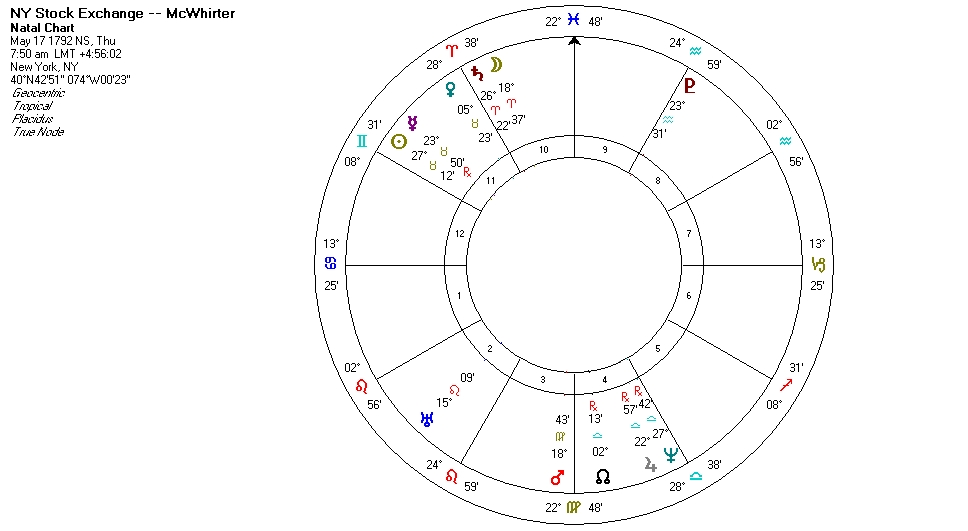
McWhirter rectified the NY Stock Exchange chart, giving it a 14 Cancer Ascendant with 24-1/2 Pisces on the MC and felt that transits to the angles would change the trends in securities, bonds and the general condition of the market. These “secondary factors” could alter the expected nodal cycle movement by up to 20%. Lunations (New Moon charts) compared with the NYSE horoscope will show the trend of the coming month.

Other factors can also throw this business cycle out of its expected rhythm. Transiting Jupiter conjunct the Node or in favorable aspects to Saturn or Uranus may give the markets a boost. Saturn or Uranus in hard aspect to the Nodes should depress prices. The positive or negative aspects between transiting Saturn and Uranus can also be used to forecast major trends. Louise felt that both the signs of Gemini and Cancer related to the United States, so Jupiter in these signs was helpful, while Saturn, Uranus and Pluto here were not.

To forecast for individual stocks, McWhirter utilized incorporation dates and their solar charts. If their natal planets connect to the NYSE chart, we can expect them to follow the general market’s trend. Lunations and outer planet transits to these charts will indicate how the particular company will fare in the coming months and years.

In 1938, McWhirter reiterated Dr. Luke D. Broughton and Evangeline Adams’ cycle for U.S. war with Uranus in Gemini, and correctly forecast that when Saturn and Uranus were in this sign from 1942 to 1944, it suggested “war, depression, government change, social upheaval and a financial panic.”

Louise McWhirter’s methods might not be as effective today as they once were, but they’re based on sound, standard astrology. We can all begin to test them by following the charts for the market and individual companies and studying the transits and lunations to them. As Louise advised, “It takes time and practice to become adept in analyzing the charts of stocks, but it is interesting and very worthwhile because it helps you to obtain financial independence through investment of a sound and practical nature.”

My biographical sketch of Louise McWhirter is here.

McWhirter Theory of Stock Market Forecasting is on Amazon.

Louise McWhirter

Search the web and you’ll find plenty of information on financial astrologer Louise McWhirter, though all of it relates to her 1938 book, McWhirter Theory of Stock Market Forecasting. Her low profile has even led some to speculate she was only a pseudonym for W.D. Gann (a rather sexist theory proposed by a man). But yes, she did exist.

Wikipedia shares information from a family member’s posts on Ancestry.com. Martha Louise McWhirter was born in 1896 in New York City, and we can find additional family information in Census records. Her younger brother was born two years later. Her father, Robert, was from Texas and her mother was from France. By the time Louise was 14, she was living in Maryland, her father had remarried and he was now a gardener and shareholder in a cooperative farm, which must’ve been an unusual situation at that time.

Louise’s parents had divorced and her mother returned to New York, working as a department store clerk. She died when Louise was only 21 years old.

McWhirter married John Mitchell Henry soon after, and the couple settled in Bayonne, New Jersey. They eventually owned their home and had five children – making it obvious why Louise didn’t publish her book until her early 40s. John worked as an assistant engineer at an oil refinery and Louise was a stay-at-home mom. Apparently she used her middle and maiden names for her work for privacy. She had studied the astrology of financial markets for years and one would guess that she made some modest investments herself. Perhaps she did readings for clients.

Evangeline Adams and her teacher Catherine Thompson had used some financial forecasting techniques beginning in the late 1900s. The stock market crash of 1929 brought more interest in predicting the highs and lows of the market. Sepharial and L. Krohn had written a few books on the subject in the ‘teens, W.D. Gann was also writing by that time, and James Mars Langham and L.J. Jensen had published financial astrology texts in the early ‘30s. McWhirter says she originated the New York Stock Exchange chart, and Graham Bates credits her with rectifying it.

We don’t know exactly who Louise’s astrology teachers were. Her home was within commuting distance from Manhattan, where she might have taken classes with one of Evangeline’s former employees like Iris Vorel, Myra Kingsley, Nella Webb or Lynn Wells. Other New York astrologers at the time included Elizabeth Aldrich and Katherine Taylor Craig. Astrologer Juliet Pontin had a home in New Jersey and an office in the city.

McWhirter used the North Nodal cycle, transits and lunations to the NYSE and incorporation charts for long and shorter-term forecasting. She was a Libra with Jupiter in Virgo and her book is a clear and workable instruction manual on how she used astrology to forecast the ups and downs of the markets. As she said, “It is no longer necessary to be wiped out on the Stock Market. That is a sign of ignorance.”

I’ll share more about her book and forecasting methods in a later post.

McWhirter Theory of Stock Market Forecasting is on Amazon.

The Moon: Fact and Symbol

We’ve come to know a lot of facts about the Moon, but its astrological – symbolic or metaphysical – meaning is completely at odds with science. It’s a good example of how differently astrologers and materialists see the world.

Scientists see the universe in terms of physical characteristics. The InfoPlease encyclopedia talks about the history of our knowledge of the Moon’s physical characteristics – from Galileo taking a closer look with his telescope in 1610 to the Moon walk in 1969 and beyond. The Moon has no atmosphere, though there may be “water ice” in its soil, according to space probes. Most of it is made up of powdered rock and rubble, with craters from meteorite impacts. It is “an essentially static, nonevolving world.” In other words, it’s dead.

Dr. Luke D. Broughton (1828-1899), a homeopathic physician and astrologer advised us that, “God appears to have made the world upside down, and things appear inverted to men as well as to babies, the first time they look at them; and men, like babies, have to learn to see things aright.” The symbolic meaning of the Moon isn’t apparent (and may even be considered “occult” – secret, concealed or not easily recognized).

Astrologically, the Moon’s meanings are the virtual opposite of its scientific, physical attributes. We know it symbolizes our emotions and feelings. We look to the Moon in the horoscope to answer questions about fertility, birth and growth. And it’s often associated with life-giving waters, cycles and women.

We might say that the scientific view of the Moon is totally left-brained (using logic, facts and numbers) while the astrological one adds right-brained thinking (focusing on the creative, intuitive and emotional meanings). Scientists derogatorily think of our use of symbols as “magical thinking,” since they see no connection between meaning and the world around us.

Everyone sees meaning in different things in life, but it’s a shame that science is often so dismissive of astrology – they cut themselves off from worlds of understanding. While we know that we live in a vibrant, animate universe.

Evangeline Adams Astrology Podcast

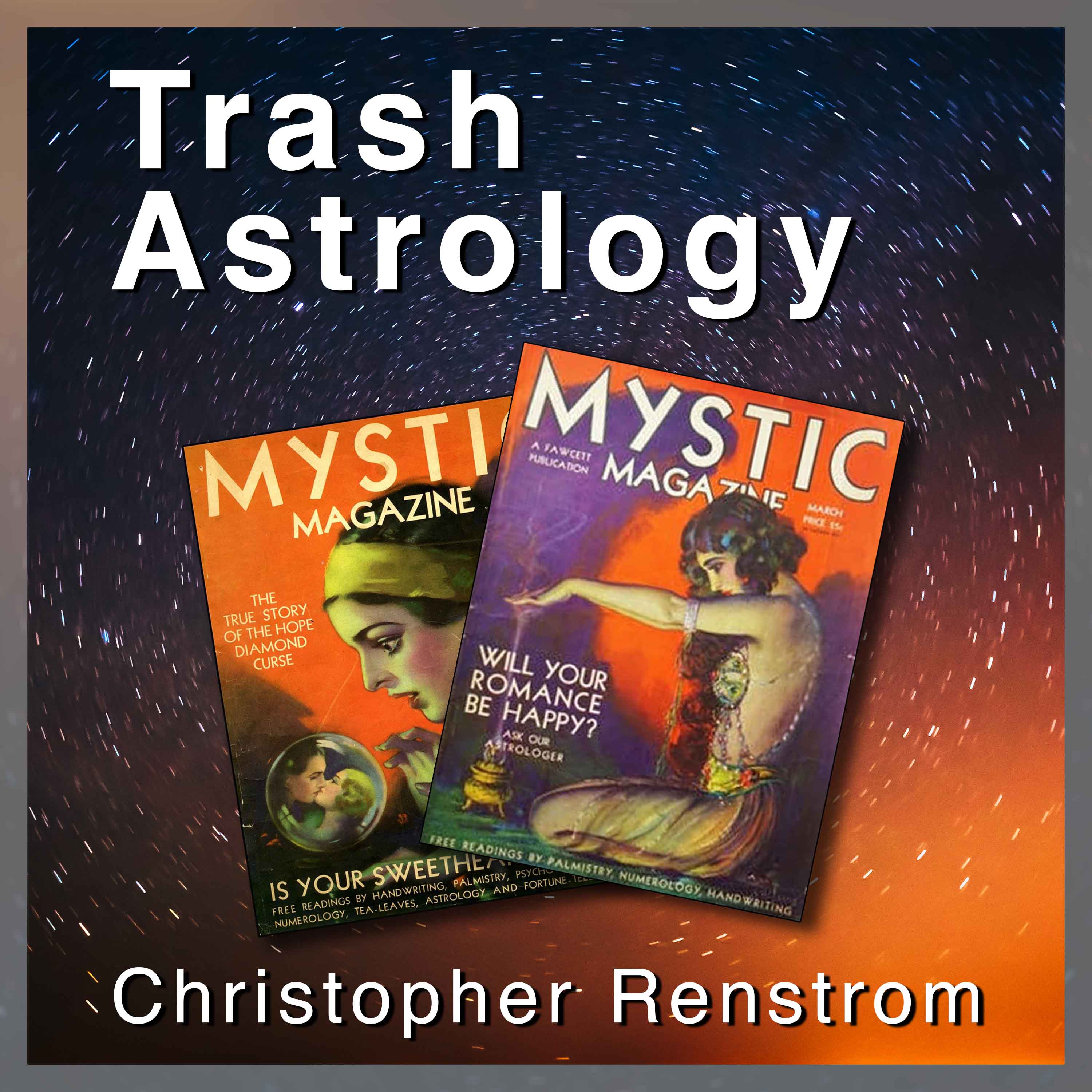
Chris Brennan and Christopher Renstrom talk about my book, Foreseeing the Future: Evangeline Adams and Astrology in America on the Astrology Podcast.

They cover Adams’ New York City arrest and trial, her impact on astrology, Trash Astrology
and the history of astrology in the U.S. It’s fascinating!

Transiting Jupiter was in Sagittarius in Adams’ 9th house as she returned to the airwaves. It trined her Moon and squared her Venus and Ascendant when the Astrology Podcast went live.

Evangeline Adams Bio Update


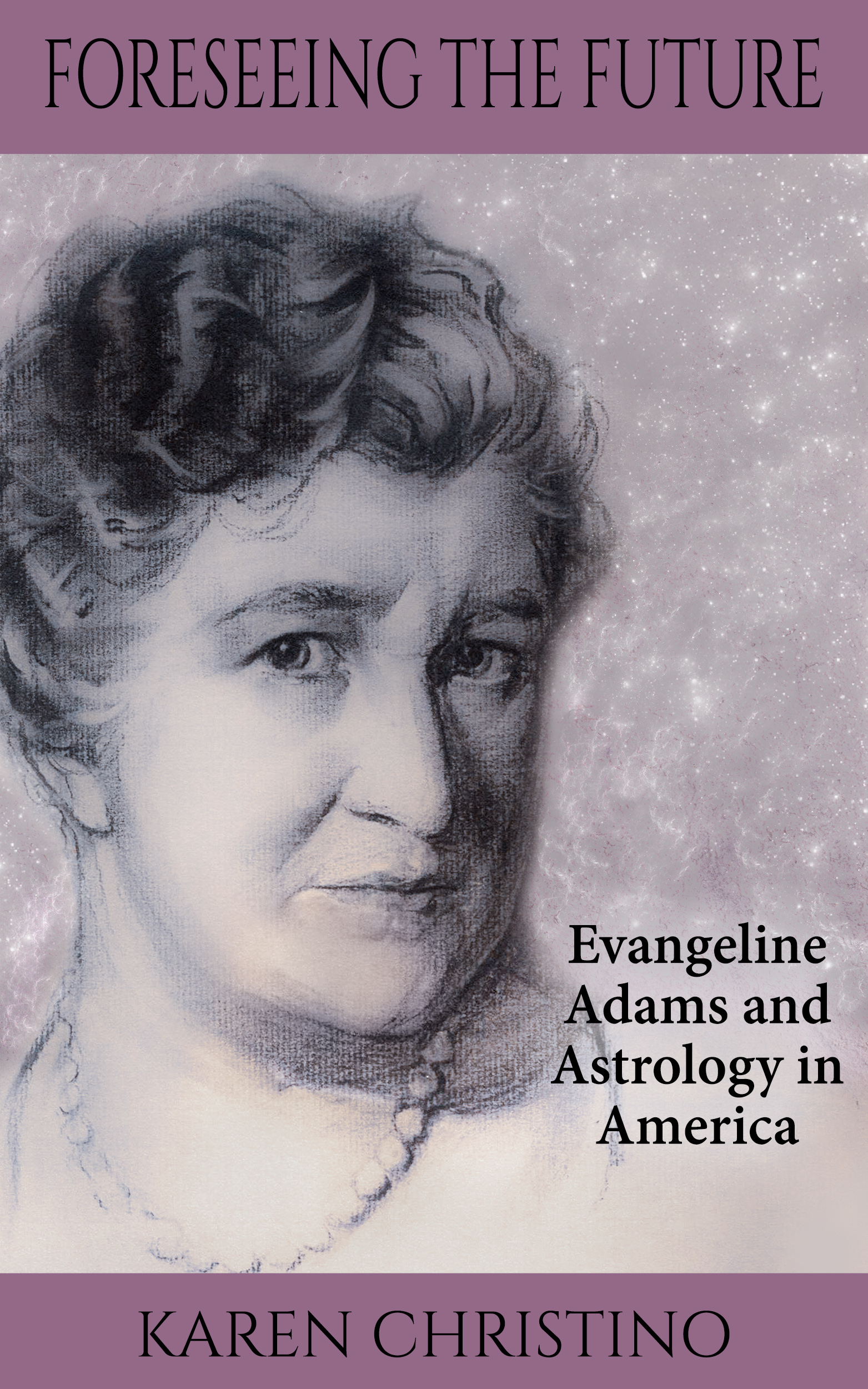
Amazon.com is pushing the old (2002) version of Foreseeing the Future: Evangeline Adams and Astrology in America and only brings up the new version in digital. (They must have some in stock that they’re discounting.)

If you’re interested in the 2019 update, please use this link, and be sure to order the cover featured here.

Jane Austen… Again

Over 200 years after her death, Jane Austen’s popularity continues to soar. Her numerous book spin-offs include plays, film adaptations, soft-core porn sequels and even things like Pride and Prejudice and Zombies. With Neptune rising in her horoscope, it appears that everyone can see something different in Austen.

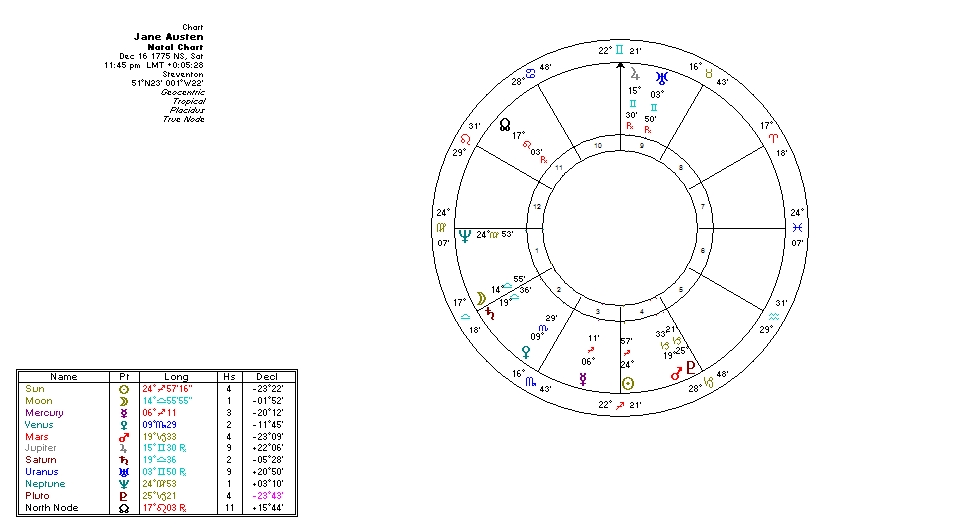
Neptune conjoining the Ascendant in Virgo in Jane’s chart makes her work multi-layered. Her books give us her personal impressions and are true-to-life reflections of daily concerns that strike a chord with readers, perhaps because there is usually some romanticism and often the suggestion of happy endings. But typical of Neptune, we don’t even know what she looked like!

Austen may not always be what she appears, especially as Neptune squares her 4th house Sun in Sagittarius. Commentators have seen her as a conservative, a house-mouse and a feminist (she never married and while tied to her family, she produced great novels). Her Mercury in Sag. in the 3rd attests to her need to write, and it opposes Uranus in the 9th house, giving her an independent outlook. Jupiter in Gemini in the 9th shows her education and the ability to publish, especially as it trines her Moon and Saturn straddling the 2nd house cusp. This aspect is probably part of what has continued to keep her books popular with readers, as Saturn can bring longevity. (While she sold some work during her lifetime, Jane did not make much money at it.) Venus in Scorpio indicates her deep feelings.

The Moon in Libra conjoining Saturn gives Austen a consistent interest in relationships, which were both persistent (especially those with women) and limited (she quickly broke off an engagement). The Moon and Saturn also square Mars in Capricorn in her 4th house, suggesting responsibilities and obligations to the home and family. Her life had limitations. Saturn squaring Pluto in Capricorn shows her pragmatic and realistic side. The Sag. and Capricorn planets combine to make her work both humorous and ironic.

With Pluto trining the writer’s Ascendant in 2020 and returning to its natal place in 2021, the recycling of her brand will probably continue. Hopefully some of it will get to the heart of what makes Jane Austen special.

Jane Austen was born on December 3, 1775 at around 11:45 pm in Steventon, Hampshire, England, according to a letter from her father – see Astrodatabank.
Helena Kelly’s feminist analysis, Jane Austen, Secret Radical, deconstructs Austen’s life and work and provides an encyclopedic look at the history and culture of the time.

Foreseeing the Future Review

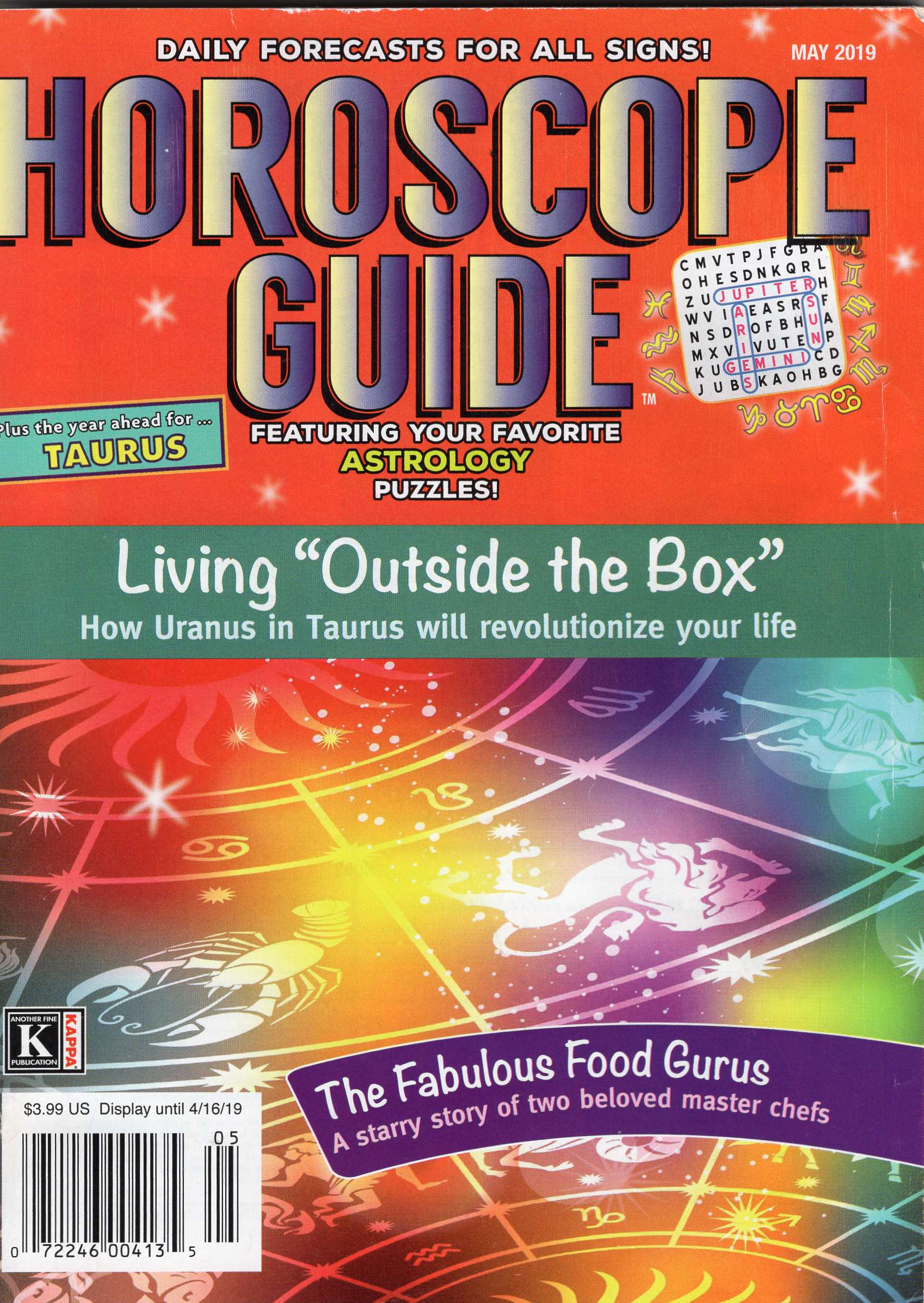
I’m thrilled and flattered to see Ken Irving’s review of the update of my book Foreseeing the Future in the May 2019 issue of Horoscope Guide magazine. He says,

“Karen Christino’s revised edition of the outstanding Evangeline Adams biography Foreseeing the Future may be the same story, but it covers Adams’ life in more depth than the first edition, so Christino has taken her original, unique history of an American astrologer, and made it much, much better. If you already have the original on your shelf, get the revised edition. If you have never come across the original, buy this newer edition. Karen Christino is a wonderful writer, and this is a wonderful book to read.”

For more on the book and links to order, click here.

Measles!

New York’s Commissioner of Health and Mayor de Blasio just ordered mandatory vaccinations for all people in four zip codes in Williamsburg, Brooklyn who haven’t demonstrated immunity to the measles. It seems like NYC is caving in to its 9th house Neptune, exaggerating people’s fear as well as their reliance on modern science and medicine. It highlights the fact that in almost all broadcast media, science and medicine are universally judged to be both “good” and “right.”

One might understand ordering unvaccinated children to stay home from school, as they also did in Rockland County (though the order was struck down by a judge). I don’t like to court controversy, and frankly I’m not sure what I’d do if I had kids.

This is a disease that 60 years ago was considered “not particularly dangerous in the young, unless they are exposed to a severe drought of cold air. In old age it is much more dangerous and deaths from it are not infrequent.” (World Scope Encyclopedia, 1958) Adults can certainly make up their own minds. In my parents’ day, measles was considered an expected disease that many experienced in childhood (it shouldn’t be confused with Rubella or German measles, which may be dangerous to unborn children).

As of today, the New York City Department of Health reports that there are “285 confirmed cases of measles in Brooklyn and Queens since October.” 228 of them were in Williamsburg, the neighborhood that now has the mandated vaccinations. That’s about 38 cases a month for six months. Not really an epidemic.

Measles comes and goes and has never been completely eradicated. Yet if you listen to our scientifically-minded officials, we’re in a state of emergency. Neptune is leading them to a place of hysteria. We are not talking about Typhoid Mary here!

As astrologers, we know that science generally attacks our beliefs. They are now going further. My objection to the Court Order has to do with the general reliance our society has on western medicine. While we have to admit that they can be helpful at times, my own experience, as well as those of my family and many friends, is that doctors over-test, over-treat and over-prescribe. These things often weaken the body further. And of course the system is in a shambles. I wish I could find a medical doctor who could get to know you and give you sound advice. In my experience, they have always been few and far between. They, too, are squeezed by the insurance companies and are also earning a lot less than they used to.

Any evening news will routinely report on the latest scientific developments and breakthroughs. Most of them relate to pharmaceuticals. What they don’t tell you is that most of these are in very early preliminary trials. And if you pay attention, you’ll notice that they usually exhibit an extremely strong bias toward science. I have yet to read or hear – except in a few special interest publications or independent websites – any opposing views. Isn’t there room for disagreement?

The Saturn and Pluto stations this month conjoin the City’s 4th house Mercury in March, suggesting paranoia and control, and the Nodes are involved in that pattern too. Jupiter is stationing near the midpoint of The City’s Venus-Mars conjunction in Sagittarius, and opposite its Neptune in the 9th: an over-reaction.

Astrology to the Rescue!

It’s such a common movie and TV plot: a person is at a crossroads and they don’t know what to do. Should they marry X? Go to school? Change jobs? There’s a lot of drama before the protagonist makes the right (or wrong!) decision. It often leaves me thinking that, if they’d just go to an astrologer, things would be a lot easier.

Astrology can answer so many questions of life, perhaps especially those related to the angular houses of self-expression, relationships, career, home and family. A horoscope is like a map or compass showing your life’s pattern. While it can’t provide specifics, it can often tell us more about all of the following:

The areas of life and types of experiences that should come easily to us;
Where challenges could occur, with suggestions to overcome them;
How to best develop your talents;
What to expect from partners, superiors, lovers and friends;
How uncontrollable events may impact on you and how to best address them (things from the outside world, culture or society);
Where your greatest opportunities could appear and when to expect them;
If it’s better to get married now, later or never;
How to maximize your assets;
How to overcome your liabilities;
The types of career that you could succeed in and what to expect along the way;
If a problem is temporary or long-term, when and how it may be resolved;

And much more! In fact, for every area of life, there’s probably an astrologer who can give you more insight.