Dueling Elections

When an electional chart works, events should flow smoothly and allow you to accomplish your goal. Might things turn out differently if we started earlier or later? It’s hard to say, since there’s usually no way to compare. But Nellie Bly and Elizabeth Bisland’s 19th century race around the world gives us two departure times for the same goal.
Nellie Bly was an early undercover reporter who famously had herself committed to a mental institution in 1887 and shared her experiences in the sensational New York World. She subsequently exposed sweatshops, jails and lobbying practices. Later, 25-year-old Bly convinced the editors to support her attempt to beat Jules Verne’s fictional record from Around the World in 80 Days. Her ship departed for Europe from Hoboken, New Jersey on November 14, 1889 at exactly 9:40:30 a.m.

Capitalizing on the publicity, Cosmopolitan magazine sent its own writer, Elizabeth Bisland, on the same journey in the opposite direction. Bisland was a freelancer from the south who only had six hours to prepare. Her train left Grand Central Station at 6:00 p.m. the same day for the west coast. How do the event charts compare?

Nellie Bly left in the morning. Jupiter rises, and all the rest but Neptune and Pluto are above the horizon. The Sagittarius Ascendant signifies a long trip, though Jupiter in Capricorn is not at its best (the reporter did pack light, bringing only one carry-on bag). But Venus in Libra in the 10th house of success is a final dispositor of the chart (all planets by traditional rulership lead to it), and its conjunction with Uranus shows the attention-grabbing nature of the event.
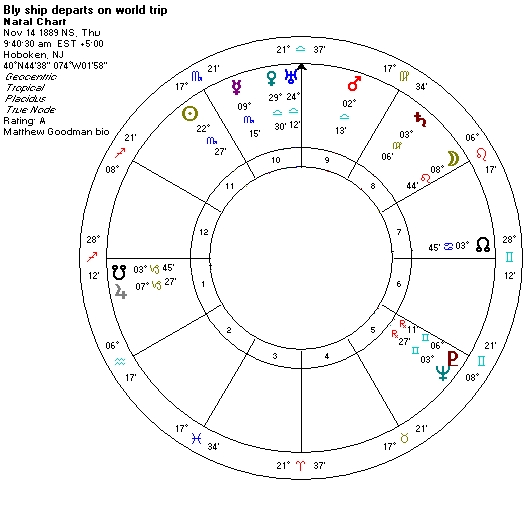
While the horoscope isn’t high in essential dignity, rulerships strengthen some key planets. Jupiter in its detriment in Capricorn squares Mars in the 9th house but also exalts it. The combination perfectly describes the pioneering journey and highlights initiative and speed. Mercury in Scorpio in the 10th sextiles Jupiter, and it’s also exalted by Saturn in the 8th house, which trines Jupiter, symbolism for both movement and follow-through (as well as the support of a major publication). Saturn also exalts Mars.

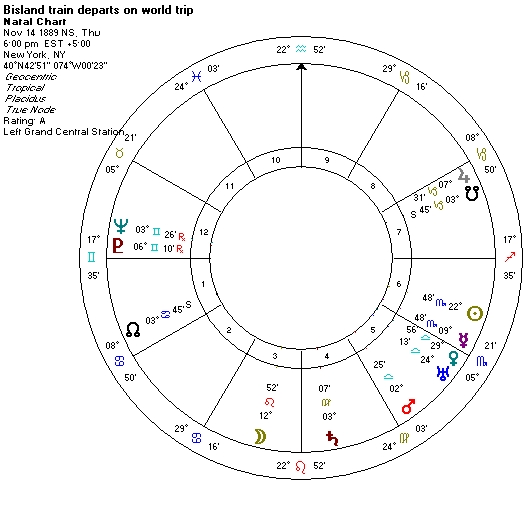
Bisland’s trip of course has the same dignities. But she left after sundown, when most planets were below the horizon, and the Ascendant ruler Mercury fell in the weaker 6th house. (Its sextile to Jupiter conjunct the 8th house may confirm the fact that Cosmopolitan’s editors bribed some carriers to facilitate the trip.) The Midheaven ruler, Saturn, showing the final outcome, is below the earth in the 4th. And while electrifying Uranus now forms a nice grand trine with the Ascendant and MC, dignified Venus is in a relatively weaker position near the 6th house cusp.
As we’d imagine, Nellie Bly completed the trip in about 72 days and 6 hours, receiving great acclaim. Elizabeth Bisland returned to New York 4½ days later. But if the departure times were switched, would it have worked out differently? Event and election charts are not stand-alones, and the natal charts always tell part of the story.

The journey was Bly’s idea proposed a year earlier, and with Jupiter in Scorpio, her Sun conjunct Pluto and Moon all in Taurus, she was determined and had overcome an impoverished background. Transiting Jupiter approached a trine to her Taurus planets at her departure, and transiting Uranus trined its natal place.

28-year-old Aquarius Bisland was also independent and self-supporting. Transiting Jupiter trined her natal Saturn, and she neared her Saturn return, both heavier influences. The trip also reflected her natal Saturn square Uranus, bringing a sudden development to her life. Like Bly, she was probably well paid for her efforts.

I’m not sure an astrologer would have elected either of these charts, though both travelers returned safely. If we wait for the ideal time to act, we could be waiting a long, long time.

Nellie Bly was born on May 5, 1864 in Cochrans Mills, PA. Elizabeth Bisland was born on February 11, 1861 near Fairfax, Louisiana. No times of birth are available.

Data and information is from Matthew Goodman’s Eighty Days: Nellie Bly and Elizabeth Bisland’s History-Making Race Around the World.

About my Amazon links.
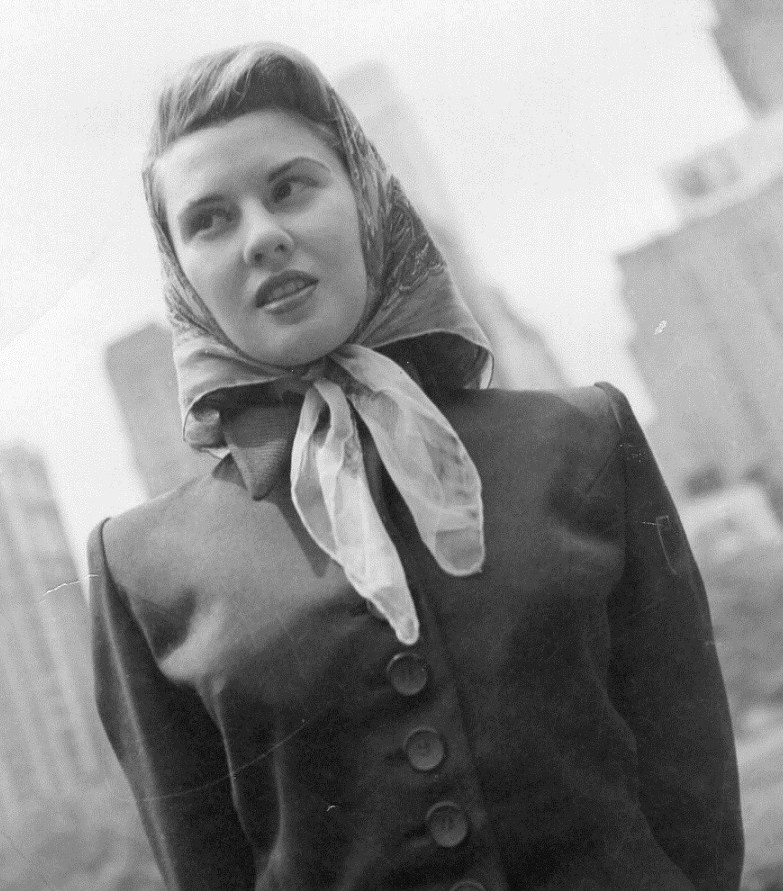
An Astrological Life

My mom, Renée Randolph, was my first astrology teacher. She began studying astrology in the late ‘60s and was immersed in the New Age movement as many metaphysical topics became more easily accessible.

Renée was born in upstate New York and came to the City on her own. With four planets in the 9th house, she worked as a bilingual secretary and later married and raised a family on Long Island. (The photo shows her in Bryant Park when she first came to New York City in 1951.)

By 1968, she had become somewhat restless and bored, and eagerly accompanied a friend to a local Edgar Cayce “Search for God” study group run by Burt Davis, the brother of the famous psychic’s stenographer. She was delighted to meet so many like-minded people for the first time in her life. As Uranus through her 11th house exactly sextiled her 9th house Sun, and Neptune in the Scorpio closely trined it, she felt her world had opened up.

A few friends from the group became interested in astrology and Renée joined them. They were mothers with young children who found it hard to get away to the City, the only place an astrology teacher could be found. So they devised a plan: one would attend the weekly classes, take copious notes, and later meet with the others to share the lesson. The friends were fortunate to study with Zoltan Mason, who focused on Jean Baptiste Morin’s 17th century technique of astrosynthesis.

Although her chart held a challenging pattern with the notable 1931 Saturn-Uranus-Pluto T-square, Renée’s Sun conjunct Jupiter in the 9th house brightened her life and gave her lucky breaks on many occasions. Her early life had been difficult, but she was a true believer in the transcendent world, and astrology only strengthened her convictions. She was strong minded and pragmatic, with an ironic sense of humor.

Renée was a prodigious reader, who collected many popular astrology books and regularly picked up copies of American Astrology and Dell Horoscope. She read about the afterlife, reincarnation, dreams, ESP and psychic phenomenon, learned meditation, practiced yoga and had some amazing personal experiences with regressions.

While I was initially a skeptic, it wasn’t too long before I became interested in astrology too. I had access to an entire library of books and learned mainly by studying charts and talking about them. Whenever we met someone interesting, we’d get their time or at least their birth date. We’d see what was happening during major life events and speculate on the rising signs of our favorite TV and movie stars.

Renée found it easy to begin doing readings professionally as there was great awareness and interest in the 1970s, though not that many who practiced in our area. She often advised people to wait for stressful aspects to pass before making major decisions.

Renée Randolph wrote a Sun sign column for a Westchester entertainment magazine called 911 for a time, and co-wrote Star Success: An Astrological Guide to Your Career with me in 1991. She also helped me with quite a bit of research for my other Sun sign book, Your Wedding Astrologer.

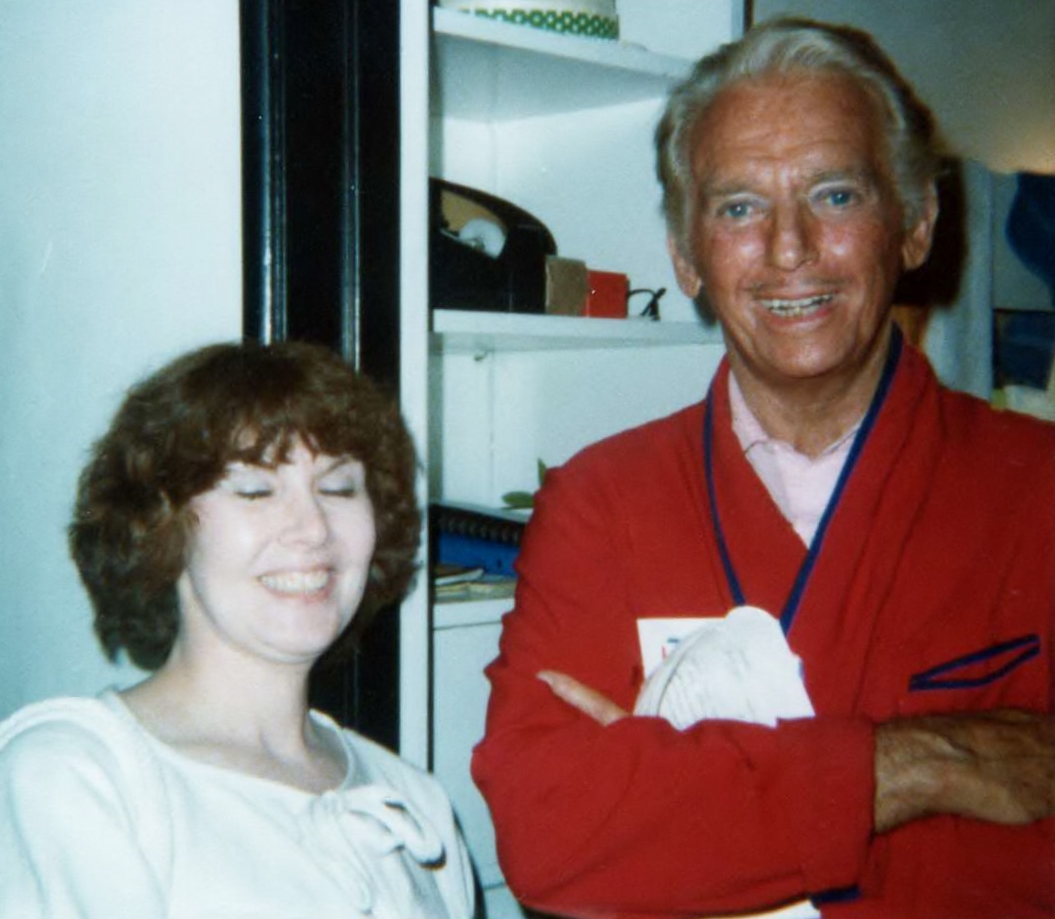
With Jupiter in Leo, Renée was attracted to celebrities and had a few prominent clients. One was Peter Savage, who co-wrote boxer Jake LaMotta’s memoir, Raging Bull, on which the Oscar-winning de Niro/Scorsese film was based. (Upon being introduced to the bull himself, she jauntily quipped, “Hiya Rocky!” to which he sulkily replied, “I’m Jake.”) She read Douglas Fairbanks, Jr.’s chart and developed an acquaintanceship with the old-time film star in the 1980s. And she coerced talk show host Dick Cavett to get his birth certificate and time after I worked with him in summer stock one year. (The photo shows Renée backstage with Fairbanks in 1978.)

Renée Randolph lived a long and full life and passed peacefully in her sleep in April of 2020 at nearly 89 years old. When she discovered astrology, she felt she had truly found her niche. It enriched her own life and also uplifted and inspired the many who she connected with for decades.

About my Amazon links.

Mountain Astrologer Review

I was delighted to read Mary Plumb’s review of my new book Tecumseh’s Curse on The Mountain Astrologer blog:

“Christino’s book is a nuanced and wide-ranging weaving of this history… an exceptional work from a seasoned astrologer who weaves techniques and historical details into an engaging, evocative and substantive book. Highly recommended.”

Read the full review here.

Read the book’s introduction and more reviews here.

Looking Forward

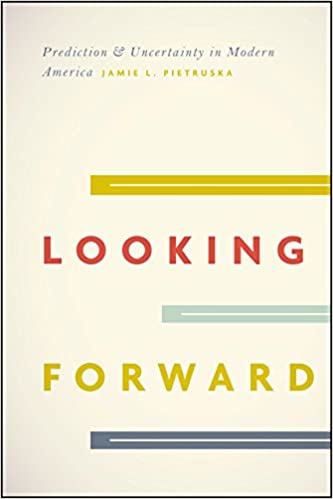
The uncertainties of life often lead to a greater interest in predicting the future. Jamie L. Pietruska’s book Looking Forward (2017) documents and analyzes futurism in the late 19th to early 20th centuries and looks at how forecasting crept into daily life. Pietruska considers the development of weather, market and economic forecasts (all of which had skeptics and detractors) and there’s also a well-researched section on fortune telling.

“Fortune tellers” include astrologers, card readers, palmists, mediums and psychics, who’ve been criticized and prosecuted in the U.S. since before the Civil War. Always popular (and perhaps because of it), they were denounced by scientists, the religious and mainstream society, and sometimes linked with crimes like counterfeiting, prostitution and even abortion (the presumption was that practitioners were usually scamsters and con artists). In the late 1800s, district attorneys and police began campaigns to prosecute fortune tellers in their cities; their stories were covered in dramatic fashion in daily newspapers (where the practitioners often advertised).

As early as 1895, well before astrologer Evangeline Adams’ first arrest in New York City in 1914, a fortune teller used the legal argument that she only read palms and did not “pretend to tell fortunes” (the legal jargon of the time). And in 1897, a Brooklyn jury agreed with the defense that palmistry was a recognized science, and acquitted the reader in two minutes. By the early part of the 20th century, these cases were often decided on character and intent, as the judge did with Miss Adams in 1914.

Pietruska seems as much an anthropologist as a historian; she documents the acceptance of antiquated laws and how society changed. This is a carefully researched work, and my book, Foreseeing the Future: Evangeline Adams and Astrology in America was quoted several times. It’s rewarding to see the same type of scholarly citations used for the other subjects. Astrology has a compelling history, and it’s refreshing to see it simply addressed as history, without the common “we know better” critiques.

There’s also a fascinating section on Adena Minott, a Jamaican-American businesswoman and activist who opened a “character reading” school in New York City that included phrenology, physiognomy, psychology and palmistry. The author shows that Minott’s story “reveals how antidivination law was used to enforce segregation in early twentieth-century cities as well as how the professional authority of a black educational institution challenged racial discrimination.” (Minott prevailed.)

The epilogue includes a look at the 2016 Trump election, when many mainstream and metaphysical forecasters miscalculated. People continue to crave predictability, despite the fact that all forecasts retain some degree of uncertainty. Like many astrologers, I favor knowing as much as we can.

Buy Looking Forward on Amazon.com
About my Amazon links.

A Simple Horary

When I first became interested in horary astrology, I’d try to get an overall impression of the chart.  What was strong?  What was weak?  What was notable?  General considerations like these can often hint at an answer.  When I do horaries these days, I still start there.  You can’t ignore the rules, but I find I often don’t need a highly detailed, rigorous analysis to get the correct answer, particularly with simple questions. 

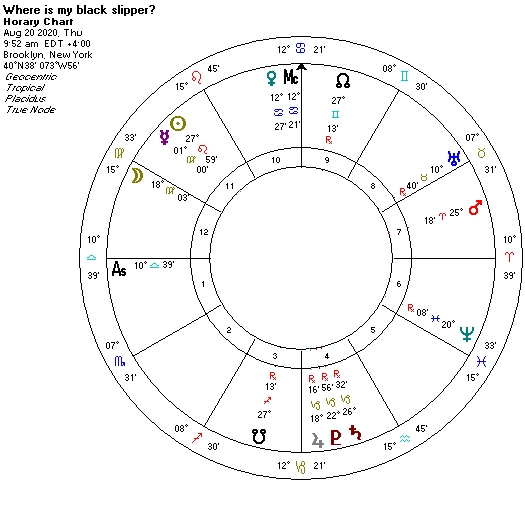
On Tuesday, August 18, 2020, when much was closed due to the coronavirus, I changed into sneakers to run to the grocery store, leaving my slippers on the bedroom floor.  When I returned, only one slipper was there.  I searched the room, under dressers and near my other shoes.  Nothing.  It was puzzling; a slipper doesn’t just disappear.  When it didn’t turn up, I ordered a new pair the next day.  But it nagged at me – what had become of the slipper?  I finally did a horary at 9:52 a.m. on August 20. 

With all the personal planets above the horizon, the general tenor of the chart looked promising with the Moon given nice trines all around.  And there’s a lot of essential dignity, with the Sun in Leo, Mercury in Virgo, Mars in Aries and Saturn in Capricorn, all in the signs they rule, making them more helpful.  Definitely more of a “Yes” than a “No” chart. 

The Ascendant ruler, representing me, is Venus in Cancer conjunct the MC, which also seemed good:  a benefic in the house often associated with success.  Venus squares the Ascendant and opposes Jupiter in Capricorn, so I was at cross-purposes with myself, clinging to a comfortable old item that remained out of reach. 

The Moon is the querent’s co-ruler, and in Virgo in the 12th house also nicely describes my bewilderment over the small, functional, missing item.  The Moon had trined Uranus in the 8th house in the past, showing a sudden event that remained obscure.  It would soon oppose Neptune, suggesting that the mystery will remain, at least for a while.  But the Moon’s double-approaching trines to retrograde Jupiter, Pluto and finally Saturn in the 4th house were hopeful signs that the slipper should be home where I expected it.  Certainly there would be an end to the suspense! 

The Moon is ruled by the dignified Mercury, which is good, but combust the Sun – not so good.  On the plus side, I felt that Mercury in Virgo was a terrific significator for my lightweight little slipper, with the Sun overshadowing it somehow.  I tried to think what the Sun represented in the room and immediately thought of the floor lamp in the corner, not far from where I’d left the slippers.  I searched closer to the lamp area, though again turned up nothing.  It was so clear in the horary!  I sat there for a while thinking.  It couldn’t be the ceiling light or the lamp on the night-table, nowhere near where I’d put on my sneakers. 

What else in the room was like the Sun?  It finally hit me:  the radiator right next to the floor lamp – not light, but heat!  The radiator cover is about an inch off the floor in some places.  I slid my hand under it and found the missing slipper.  It seemed amazing that it could’ve slid under such a narrow opening, but I must have kicked it across the floor as I left the room.  Mystery solved. 

The new slippers were delivered a few days later.  If Scorpio on the 2nd is my purchase, and Mars in Aries the new item, its square to Saturn shows my rush to order a replacement as well as my overcompensation.  Not the worst outcome from a Mars square Saturn!

Astro-Genealogy

My great-grandmother died in the 1918 pandemic, well before my father was even born.  We only have a few records of her life, though her original birth certificate actually has a time, so astrology can tell us more.

Mariantonia de Stasio was born in Montecalvo Irpino in Avellino, Italy in 1870.  The country was unified in 1861, but the south had a high tax burden, limited medical care, transportation problems and land shortages.  About a third of the town’s residents left for the U.S. between 1892 and 1924.

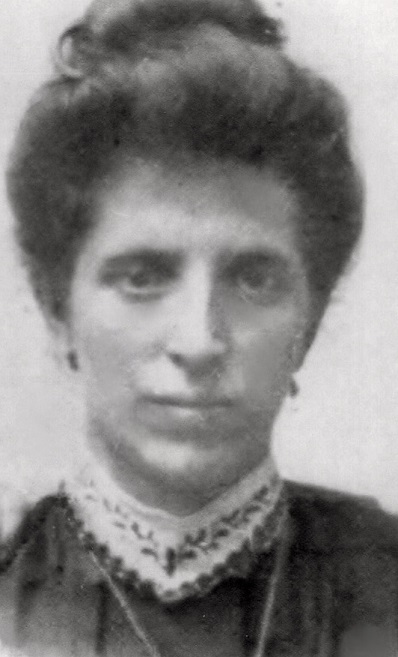
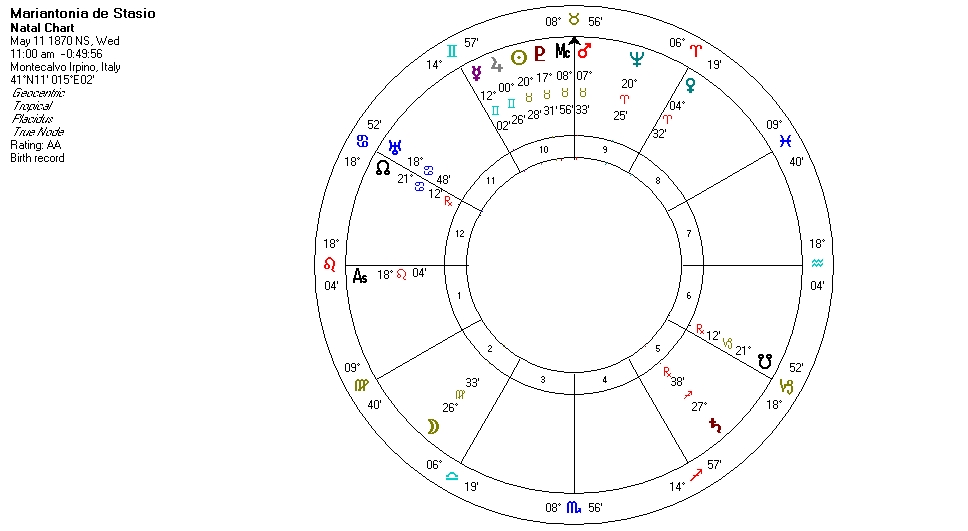
I’m not sure of the accuracy of the 11:00 a.m. birth time on Maria’s birth record.  But it gives her Leo rising, which seems appropriate, as her photo shows that she had good taste and presented a polished appearance.  She wore a beautiful lace collar and earrings, and her hair is perfectly swept up.

Maria’s Sun in Taurus conjunct Pluto, as well as her Moon-Venus-Saturn T-square, suggest some trauma and limitations in her life.  Her father died before she married at the age of 20.  Her husband, my great-grandfather Donato, travelled to New York City in 1895, and their second daughter died in Italy only a few months after he left.  But with Jupiter trine her Moon and conjunct her Sun, emigrating to the U.S. was probably a good choice for Maria.

Maria and Donato had six more children in New York, one of whom died in infancy.  Census records show that they lived in tenement apartments in Manhattan’s Little Italy on Mott Street and Hester Street.  By 1915 they had moved to Bridge Street in Brooklyn’s Vinegar Hill, on the other side of the Manhattan Bridge. 

Maria’s mutable Moon in Virgo square Saturn in Sagittarius could also indicate their less than ideal housing situations.  She had been trained as a tailor and must have been skilled, with a strong work ethic.  Her oldest daughter Rose was working as a coat finisher when she was only 13.  Like many women of the time, they probably sewed piecework in their home. 

The Moon rules Maria’s 12th house relating to the immune system, and Saturn rules her 6th of illness.  Saturn is then placed in her 5th of children.  It seems like her many responsibilities may have weakened her health.  She might have also suffered from anxiety or even depression. 

The flu pandemic hit NY in the spring of 1918, and became much worse that fall.  With transiting Jupiter and Pluto in Cancer and Saturn in Leo, both youthful signs, it was more dangerous to children (as opposed to the 2020 pandemic with Jupiter, Saturn and Pluto in Capricorn affecting seniors more strongly). 

Maria’s Sun helpfully conjoins Jupiter, but Jupiter in its detriment in Gemini makes it less benefic.  Mercury is dignified in Gemini and disposes the Moon, Jupiter and Saturn, so she probably overcome her limitations with common sense and the help of friends (since Mercury conjoins the 11th house).  But mutable signs can affect the lungs:  Saturn in Sagittarius might constrict her breathing, while Jupiter in Gemini presents potential lung congestion.  She contracted the flu and died of pneumonia less than two weeks later, on October 24, 1918.  Transiting Saturn conjoined her Ascendant, lowering her vitality, while transiting Uranus in the 7th opposed it.  The doctor visited but was unable to help her; she was only 48 years old.

At the same time, Maria’s progressed Midheaven at 25+ Gemini opposed natal Saturn, and her progressed Ascendant at 26 Virgo conjoined her Moon, both activating the natal Moon-Saturn square.  (It seems that her 11:00 birth time may not be that far off.)   

We often find close connections with the horoscopes of family members.  I never met my great-grandmother and we have only one photo to tell us what she looked like.  But her Pluto is only a few minutes from my Moon and the connection is both genetic and after her death!  


I wrote more about the 1918 pandemic in New York City here.

Medical astrology information in this post is from Diane Cramer’s book, Managing Your Health and Wellness. 

Read about my Amazon links here. 

The Cosmic Calendar

Christopher Renstrom’s The Cosmic Calendar:  Using Astrology to Get in Sync with Your Best Life provides a wonderful introduction to astrology, and the author’s writing skill and deep understanding of both history and cycles make this a special book.

Renstrom presents the equinoxes, solstices, elements, modes, day and night horoscopes and more with chart diagrams.  These immediately convey the multi-dimensional nature of astrology and provide an excellent introduction to help beginners look at a chart.  With perceptive and evocative descriptions, the Sun, Moon and planets in signs are addressed at length, with short interpretations of Sun and planet combinations.  Christopher writes with sensitivity, insight and emotional resonance and has created a work that’s refreshing, fun and often funny. 

We learn so much from the fact that Cancer “can’t resist the impulse to pick up things and to hold them; to cuddle, coddle and cradle.”  The Moon in Virgo “treats the body like a temple and not a pup tent.”  Jupiter in Leo should “make a big splash, not a big splat.”  Saturn in Aquarius’ “matter-of-fact way of putting things gives you the bedside manner of a Vulcan.”  Each thought is skillfully crafted to enhance our knowledge and awareness. 

Renstrom introduces essential dignities by connecting these fundamentals with the seasons, magically making a sometimes murky topic crystal clear.  The Moon is dignified in Cancer when the Northern Hemisphere is vibrant with life; it’s exalted in Taurus, the time of spring growth.  Venus rules Taurus’ month, when roses bloom, as well as Libra’s, the time for harvests.  Saturn is connected with two months of seasonal cold and dormancy.  The associations are disarmingly simple but also profound, as they strike at the heart of their meanings. 

A marvelous historical perspective is sprinkled throughout, with enlightening anecdotes about Caesar, Cleopatra and the calendar, Newgrange alignments, Roman myths, the discovery of the outer planets and other intriguing tidbits.  The book itself is beautifully designed, compact and easy to read. 

The Cosmic Calendar is like a raspberry cheesecake with the nutrition of a macrobiotic meal.  Read this book to refresh yourself on astrological basics, or simply for the elegant and entertaining prose.  Buy it for friends and family:  it should make a perfect gift for the budding astrologer on your list!

Buy The Cosmic Calendar on Amazon.com.

Out-of-Bounds Doctor

In a stunning settlement, the University of Southern California agreed to pay $1.1 billion to compensate over 700 sexual abuse victims for their experiences with long-time student gynecologist, Dr. George Tyndall.  The agreement is the largest of its kind, an admission of the gravity of the doctor’s behavior.  How is a perpetrator of such extensive abuse able to continue for so long? 

May 22, 2018 (AP Photo/Richard Vogel, File)

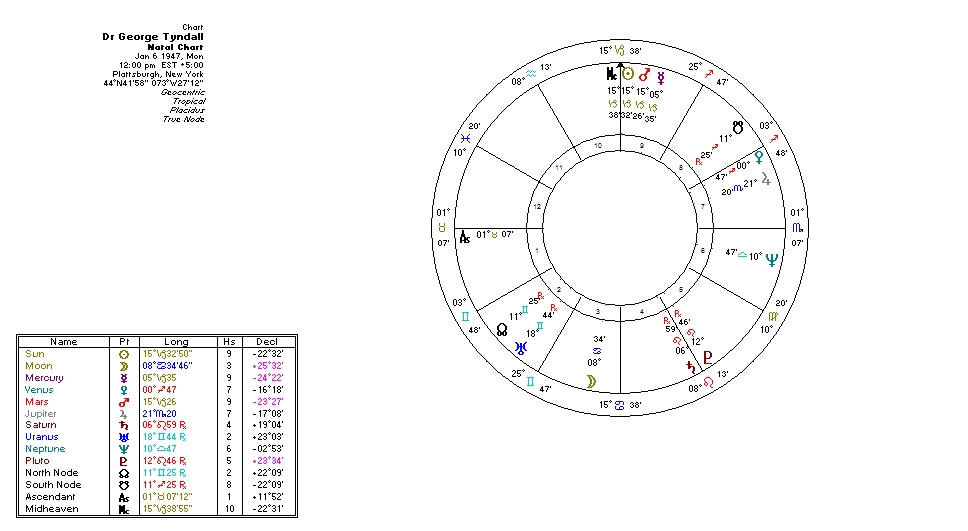
Dr. Tyndall’s prominent T-square shows his long-term position (Sun, Mercury and Mars in Capricorn), his attraction to young people (the Moon in Cancer – a full Moon chart) and his hidden, distorted reality (all square Neptune).  Saturn in Leo in its detriment conjunct Pluto and inconjunct Mercury in Capricorn seems a clear indication of his abuse of his position and power over his teenage patients.  Mars exalted in Capricorn allowed him to persist for nearly a full Saturn cycle of 27 years.  Jupiter in Scorpio sextile Tyndall’s Sun reflects his specialty as well as his ability to escape prosecution for so long.

Tyndall began the job in the summer of 1989, with transiting Saturn conjunct his Capricorn Sun.  He was suspended in 2016 as Saturn conjoined his South Node in Sagittarius.  Complaints of the doctor’s inappropriate comments, traumatizing physical acts and improper photographs of patients began in the 1990s and continued through the year of his removal.  Neptune’s squares seem obvious from both his lack of boundaries and interest in photography.  His offices were described as cluttered and unsanitary. 

Powerful placements and aspects like these don’t necessarily make someone a “bad” person.  Actresses Sandy Dennis and Andréa Ferréol, both born on the same day, channeled their Neptunian energies into more productive lives. 

Perhaps most significantly, though, are the doctor’s aspects in declination.  The Moon, Mercury and Pluto, all placed out-of-bounds (along with Mars just beginning to step OOB at 23 S 27’) show the negative expression of these energies and how Tyndall countered norms, particularly for one in a position of power and authority over young women.  Kt Boehrer associated the OOB Moon for men with having few or no children, and Tyndall also appears to have had none.  His wife, found through a matrimonial service, was around 20 years his junior and eventually returned to the Philippines.

Dr. Tyndall was charged with over 30 felony counts of sexual abuse beginning in June of 2019, as Saturn again conjoined his Sun.  His trial is pending.

Ancestry.com provided the birth date for George R. Tyndall (January 6, 1947 in Plattsburgh, NY, I used a noon chart – no time available).  The Los Angeles Times of December 19, 2018 confirms the year of birth and provided background information for this post. 

Presidential Wheels of Fortune

Why did I ever get involved with the presidents?  It must be astrological.  With a strong Saturn trine the Ascendant, my connection with them began before I even thought about looking at their elections astrologically. 

When I was a kid, my parents bought me a poster with headshots of all the chief executives.  I’m not sure why they considered it an appropriate gift for a grade-schooler, but they were both civic-minded and we all had Capricorn in our charts.  The poster stood out in black and gold on my bedroom wall, and I was fascinated by the weird hairdos and fashions.  I knew very little about the people, but named my hamster after one of them.  (Fillmore’s cage sat beneath the poster, though he never got as far on his wheel of fortune as his namesake.)

When my first book about Sun-signs and career came out, one of my radio interviews was in Tennessee.  It was election season and I thought they’d like to hear about Vice Presidential candidate Al Gore’s chances for success.  Using pretty basic techniques, I already expected Bill Clinton was likely to win, and Gore’s chart settled it. 

I’d always been attracted to forecasting, and calling the outcomes of political elections was the kind of definitive, testable astrology I liked.  Clients were interested in it, too.  I focused on the natal horoscopes for my conclusions regarding major changes, continuing on a particular path, and possible success. 

Early 20th century astrologer Evangeline Adams was no stranger to prediction, and famously called the outcomes of several presidential elections correctly.  She appeared to base her judgments, at least partially, on transiting Saturn, which is so important to career and life direction.  When I began studying Adams’ work, I became more interested in her Gemini rising U.S. chart, and took more time with my next presidential forecasts, studying not only the candidates’ charts but the country’s too.

With several correct forecasts in a row, I now had a record to uphold!  I eventually became convinced that the more things I looked at, the more accurate I’d be.  I checked transits, solar returns, progressions, solar arcs, progressed declination, planetary cycles, the candidates’ progressed to the U.S. chart, as well as their progressed to U.S. progressed aspects, and included the candidates’ spouses to see if they supported my conclusions. 

Some were easier than others.  I was skeptical that an African American president could be elected in 2008, but the prevailing transit of Saturn opposite Uranus, announcing innovation, clinched my forecast of Obama’s win.  In 2012, his progressed declination was so deeply connected with longer-term U.S. progressions that I felt his work with the country was not yet complete.  At the same time, Mitt Romney had transiting Neptune squaring his Gemini Ascendant, while running mate Paul Ryan had the mirror aspect to his Sagittarius Ascendant:  I imagined their joint hopes would evaporate.

The presidential contest between George W. Bush and Al Gore, despite being one of the closest in U.S. history, seemed to me relatively easy to determine astrologically, and many other astrologers agreed. 

My brother, a die-hard skeptic, also kept me focused on the presidential predictions.  A math person with a fixed-sign Aquarius Mercury, he argued my successes were simply coincidence.  I’d actually been correct 6 out of 6 times.  The probability of choosing heads correctly in 6 coin tosses is 1 in 64, or a 1.56 % (.0156) chance. 

But by the time Hillary Clinton ran against Donald Trump, I’d become overconfident, and transiting Jupiter trine my Moon that year only added to my presumption.  Living in New York City for most of my life, I assumed most would see Donald Trump’s run as the publicity stunt I thought it was.  I also couldn’t imagine someone with such a checkered career in the White House.  We all know the result; bias is not a good thing for astrological judgment, and the lack of an accurate birth time for Hillary didn’t help. 

I was determined to do better with the 2020 election and again spent a great deal of time with the candidates, their spouses and the U.S. charts.  I also returned to basics, and only used the techniques I was most familiar with – transits, progressions and progressed declination.  My study of U.S. Inauguration charts for my book Tecumseh’s Curse also helped me call the 2020 outcome correctly, when I realized that Saturn and Uranus in hard aspect historically suggested a change in presidential party. 

I now had an accuracy record of 7 in 8 correct, or 87.5%, versus odds of 3.13% by chance alone.  When I asked my brother what he thought, he laughed nervously and began talking about Trump’s legal challenges.  (We now know that his 60+ lawsuits for voter fraud across the country were virtually all dropped or dismissed due to lack of evidence.)  More importantly, I had refined my forecasting techniques and vindicated both myself and astrology. 

New Book — Tecumseh’s Curse

On the verge of the Jupiter-Saturn conjunction, I’m delighted to release my new E-book, Tecumseh’s Curse: Indigenous Wisdom, Astrology and the Deaths of U.S. Presidents.  I cover the Shawnee brothers linked to the “curse” and the zero-year presidents dying in office, the connections between myth and history, Indigenous culture and American expansionism, and astrology and prophecy.  The book looks at patterns in American presidential history and includes analyses of inauguration charts with a preview of the 2021 term and the Jupiter and Saturn in Aquarius era to come. 

Read the intro on my blog:  https://karenchristino.com/books/tecumsehs-curse/

To buy or for a sample go to Amazon.com.