Category Archives: metaphysics-spirituality

Jeane Dixon

Jeane Dixon was often called an astrologer but was primarily a psychic.  She wrote a daily horoscope column for years, though she used her crystal ball (literally) to get impressions for each sign.
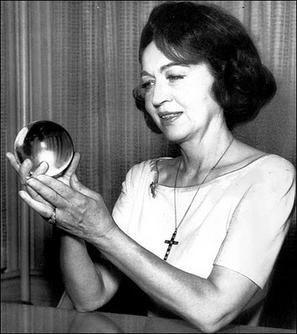
Some of Dixon’s predictions were legendary.  In 1956 she forecast a Democratic presidential win in 1960, but that the president “will be assassinated or die in office” (possibly referencing the 20-year Jupiter-Saturn pattern of deaths in office).  She’d forecast a win for Harry Truman in 1948, when most commentators expected him to lose.

Dixon foresaw a wiretapping scandal for Richard Nixon, though she thought it would “help his image.” Twenty years before Bill Clinton’s impeachment, she could see a president “implicated in misconduct, or worse.”

Jeane Dixon wasn’t always right, but she had some remarkable hits.  She read for Ronald and Nancy Reagan when he was governor of California, and was invited to the White House to meet with Franklin Roosevelt and Nixon.

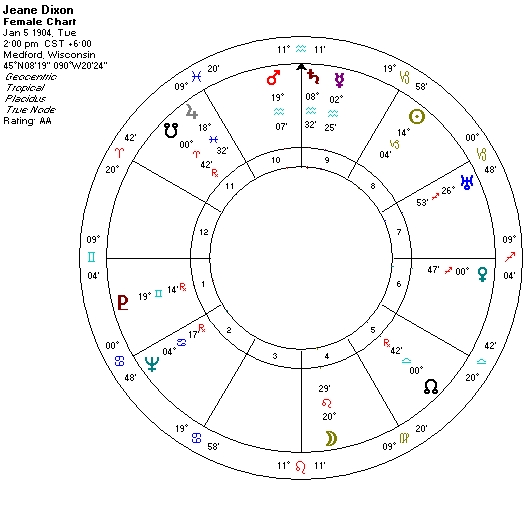
Dixon’s focus on world leaders is shown by her dignified Saturn in Aquarius conjunct her MC; it disposits much of her chart.  Her Gemini Ascendant closely trined Saturn: an immediate connection.  Her reputation was for her unusual Aquarian metaphysical skills, and she was one of the best known psychics in her time with an extremely stable career.
Her Gemini writing ability also popularized her work.  She wrote seven books, including an autobiography, a book on dog horoscopes and an astrological cookbook.  She had a Dial-a-Horoscope service in the mid-1980s, and wrote a quarterly celebrity forecast column for the gossipy supermarket tabloid The Star for over twenty years.

Mercury in Aquarius in the 9th house ruling the Ascendant gave Dixon a wide readership.  Mercury sextiles Venus in Sagittarius in the 6th house, and she seemed to love her work and its divinatory aspects.  Mercury was also inconjunct Neptune in the 2nd and she wrote from inspiration.  She was also a religious Roman Catholic who attended mass every day and felt her talents were divinely inspired.  Dixon believed that all events were foreshadowed and that she was only a messenger.

There’s a wide yod in Jeane Dixon’s chart with Neptune at the apex, and quincunxes to the Mercury-Venus sextile, connecting her Neptunian values with work and her ideals about sharing her message with a wide audience.

Jeane must have enjoyed the spotlight with her Moon in Leo in the 4th house.  She came from a family of ten children, which must have been lively with the Moon’s opposition to Mars, but never had children of her own.  She and her husband partnered in a real estate firm, with the Moon’s ruler, the Sun in Capricorn, placed in the 8th, and associated with business earnings through commissions.

But many of Dixon’s placements also relate to psychic sensitivity.  The Moon’s opposition to Mars would have given her strong impressions, and some of her predictions were spontaneous.  Pluto in her 1st house in Gemini closely trined Mars in Aquarius in her 10th house and sextiled the Moon, giving her deep perceptions that obviously went well beyond what most observed.  A Pluto in Gemini transformation in her life related to her name change from Lydia Pinckert.

The Sun in the 8th is also connected with the metaphysical world.  It sextiles Jupiter in Pisces in the 11th house, making her popular and adding an oracular touch, but Jupiter in this sign also placed Dixon within a religious and spiritual community.

Jeane Dixon died on January 25, 1997 at the age of 93 of a heart attack, in keeping with the Moon in Leo.  A museum dedicated to her life and work opened in 2002, but only lasted about six years.

Jeane’s bio on Wikipedia.   Astrodatabank rates her birth data AA.

About the Jeane Dixon Museum

Dixon’s autobiography, My Life and Prophecies.


Roger Bacon and Incorruptibility

Meagan S. Allen’s book Roger Bacon and the Incorruptible Human, 1220-1292: Alchemy, Pharmacology and the Desire to Prolong Life shows how alchemy, astrology and medicine were interconnected in the medieval world.  Roger Bacon was a 13th century philosopher and Franciscan friar, who, like many others of the time, was influenced by both the Bible and medical works, and believed that the extension of life was a valid pursuit.

Allen explains Bacon’s ideas in a consistently clear and lucid style. And while she mentions astronomy much more than astrology, at that time they were a united subject.  But given the context, it seems to me that the astrological meaning is generally intended.

Adam and Eve were given the potential to live forever, eating the fruit of the Tree of Life in Eden, which would sustain them forever.  But eating from the Tree of Knowledge, they had to leave.  And human bodies have lost their balance compared with the much longer life spans of the biblical patriarchs.

Our bodies will eventually be incorruptible through God after the resurrection, and a physical resurrection that included both body and soul was the accepted idea.  There would then be no tension between them, as both would be completely subject to the soul’s will.

Bacon was familiar with astrological works by Arabic authors like Abu Ma’shar and al-Kindi, and Greek works such as Ptolemy’s Tetrabiblos. Many texts attributed to Galen had also been translated into Latin by that time.

Not unlike today, the medical establishment offered little help for the aging process, since their focus was on disease.  People could support their health with an improved diet and natural remedies that might help extend life (prolongatio vitae).  And Bacon felt there were risks to relying on medical advice.  Prescriptions needed to suit one’s age, constitution and horoscope, but doctors often weren’t good astrologers, alchemists, diagnosticians or apothecaries.  Without these skills, treatment was left to guesswork and luck.

Lunar aspects should be considered when taking medicines, and herbs needed to be collected at the proper times.  Helpful astrological patterns could pass celestial virtues onto alchemical medicines.  Alchemical techniques (which might be termed astrological magic today) could also enhance food and stones to bring one back to health and prolong life.

The ideal was a corpus equale – a body with the elements in equal proportions, which was so balanced that it would be incapable of decay (as gold and the immortal resurrection body).  Like everything else in the universe, stars and planets were made up of four essential elements and simple humors:  sanguine blood (air), phlegm (water), choler (fire) and melancholy (earth).  Our natal horoscopes give each of us differing elemental balances.  The challenge, then, or the “secret of secrets” (secretum secretorum) lies in balancing out the qualities of the humors in the body.

A thousand years earlier, Galen and Hippocrates’ medicine also based human health on the balance of the four humors.  As medical astrology still does today, alchemy was built on this foundation.

Bacon felt that the theory of the transmutation and purification of metals could be applied to human medicine, and that alchemical medicines could theoretically help us approach immortality.  A universal health elixir would be perfectly balanced and therefore incorruptible, able to restore bodies to health.  Bacon claimed he had seen it work with skilled doctors and patients.

Meagan Allen even shares the recipe, which included a combination of honey, fruit, seeds, spices and flowers, all fermented and boiled down with various powdered gem stones and gold, and placed “under the sky” for a week or so to take advantage of the “heavenly powers.”  Other key ingredients could include the flesh and bones of the Ethiopian dragon (a large winged snake) and the Tyrian viper – which was good for old age and aided memory.

And best of all, no one need worry about a diagnosis, since the elixir had a universal nature that cured anything.  A panacea, it did not require a diagnosis, and would balance humors, lessen pain, clear vision, calm disease and slow aging, support the brain, stimulate joy and prolong life.

Those interested in medical astrology, the medieval mind or alchemy’s connection with the cosmos should enjoy reading Roger Bacon and the Incorruptible Human, a well-researched and abundantly annotated work.  Since Meagan S. Allen is a college professor, her book is another example of how ancient and medieval world views that support astrology continue to be legitimately explored today.

As an academic book, Roger Bacon and the Incorruptible Human is unfortunately rather expensive.

About my reviews and links.

The In-Between

When my mother first moved to an assisted living facility, they placed her under hospice care.  Being the stubborn and contrary person that she was, she fought them every step of the way until they disenrolled her (she lived for five more years).  We weren’t sure why she was put on that plan, but I ended up feeling it was a very good program that was more holistic than most medical treatment today.

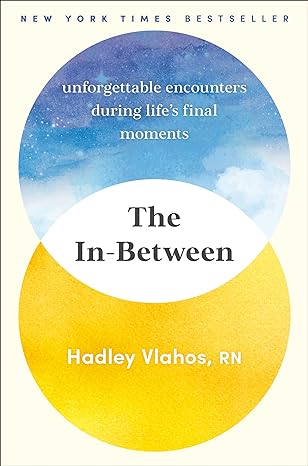
So my interest was piqued when I saw The In-Between:  Unforgettable Encounters During Life’s Final Moments, a memoir written by a hospice nurse, about her experiences with twelve patients over the course of a few years.  Most interesting to me was the medical reality of patients receiving visits from their loved ones as they neared death.

The author, Hadley Vlohos, R.N., was a teenage unwed mother when she enrolled in nursing school and later landed in hospice care.  She felt at home with the more patient-centered, comfort-driven mandate of hospice.  Hadley shares what she learned from her patients, who were usually open and candid at the end of their lives.  We follow her on her journey as she acclimates herself to the challenges of her job, gets married, goes through the death of her mother-in-law from brain cancer and learns to confront medical authorities when necessary.  Her patients range from wealthy to homeless, elderly with dementia to a young parent, slow and expected weakening to quick passages, and all offered insights and wisdom.

But it’s the unusual relationships that develop, as well as the metaphysical experiences described that were the most compelling.  Patients invariably felt calm and peaceful near the end, and many looked forward to rejoining long departed family members who had recently visited them.  Hadley herself had struggled with her religious upbringing, and she found that beliefs didn’t affect her patients’ experiences in dying.  (Even a life-time atheist was also visited by family from the other side.)

While the topic may be off-putting to many, Hadley Vlahos tells her patients’ stories with great feeling and empathy, and the book becomes a celebration of life in all its many facets.  Hadley learned that she couldn’t control everything and often had to trust both her patients and the universe and let go.  (Saturn is often invoked in the subject of death, but may also be appropriate in its sense of timing and the idea of release, too.)  All of the patients’ stories resonated with me.  In an age of AI and continual promotions, it’s nice to find a work that honors uniquely human experiences.

See The In-Between on Amazon.com.

About my reviews and links.

Eliminate TV?

Jerry Mander’s 1978 book, Four Arguments for the Elimination of Television is a counter-culture classic that analyzes the negative effects of television and advises against its use.  Mander spent many years handling TV ads for huge corporations, became disillusioned with the “establishment,” and turned to helping promote non-profits and those he considered more worthy.  But he ultimately felt their voices couldn’t be effectively communicated through the medium. 

Mass media is limited in many ways, as anyone can see from how astrology has been conveyed to a wider audience for more than 100 years.

Mander believed that human-created environments had already replaced real experience, and that television in particular narrowed perceptions (reminding me of Plato’s allegory of the cave).  TV limits the use of our senses, as well as instinct, intuition, feeling and thought, and replaces them with a hypnotic, addictive experience.  People and the environment are “dimmed out,” and we’re separated from others, the community and ourselves.  Knowledge that’s not based on direct experience becomes the norm, and aided by TV, is replaced by the influence of science, technology and industrial proof.

On the other hand, television is best at being an “advertising delivery system” since the confining experience of TV can easily implant simple, clear ideas. Programming choices are in the hands of the techno-scientific and corporate elite, whose power is enhanced by their technology, resulting in the “loss of virtually everything that qualifies as meaningful.”

Those interested in history and cycles would tend to agree with some of his arguments.  The needs of the market are contrary to human needs since “unlimited economic growth is a planetary impossibility.  It could only have been conceived by minds out of touch with natural limits.  It is dependent on a suicidal over use of resources and an impossible rate of commodity consumption.”

Artificial light obscures natural rhythms.  Like food, living things need natural light for nourishment and growth.  We’ve learned much more about how ultraviolet light is essential for synthesis of Vitamin D, and how blue light from screens can interfere with our circadian rhythms, but Mander wrote about these topics over 45 years ago.  He believed that new technology should be considered “guilty until proven innocent.”  Television was rapidly adopted, with little review or testing, and not much study of it was ever done.  Over a 7-year period, the author found only 20 articles that critically looked at the effects of television, some of which included epilepsy, eye damage, heart rate changes and exposure to X-rays (electromagnetic radiation).

Television is only able to present us with “drastically reduced versions” and distortions of nature, the arts, religion and non-western or non-materialist cultures, since they demand the interplay of the mind and senses to understand fully.  Instead, TV causes us to lose a sense of grounding in time and place.

Four Arguments for the Elimination of Television doesn’t touch on astrology, but while astrology proliferates on mass media today, much continues to be superficial.  Like other uncommon subjects in the western world, one needs time to study, experience and understand astrology.

These days, television is very different, and we’re dominated by the Internet.  But our social media platforms have become updated “advertising delivery systems.”  Jerry Mander died in April of 2023 at the age of 85, and would have seen the popularity and power of the Internet as the next stage for advertisers.  He was very prescient, if not prophetic.  But in 1977, even he admitted he didn’t know how to eliminate TV.

Four Arguments for the Elimination of Television is available second-hand on Amazon and elsewhere.

All the Beauty in the World

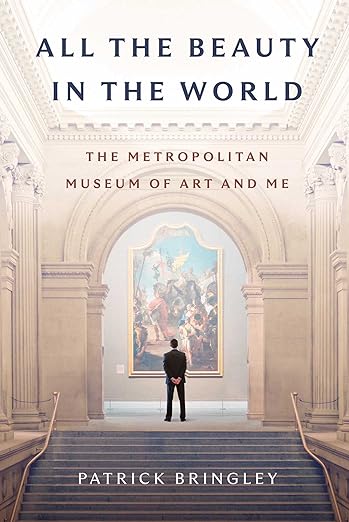
The 12th house is one of the most difficult to understand.  But when we experience 12th house issues, we can connect with them directly.  Patrick Bringley’s book All the Beauty in the World: the Metropolitan Museum of Art and Me seems to share such a 12th house journey in a compelling way.

Horary practitioners relate the 12th house to disappointments, sorrow, affliction, even imprisonment.  Planets here may show a focus on the wounded, hospitalized or withdrawn.  Al H. Morrison related the 12th to people who retreat from society to meditate, who turn inward or connect with inner guidance.

Patrick Bringley’s book chronicles his experiences following the death of his brother.  He could no longer tolerate a somewhat superficial job that required him to spend his days in front of a computer.  He had found meaning in art and instead became a security guard at the Museum of Modern Art in Manhattan.  At this 12th house institution, his co-workers joked they had “nothing to do and all day to do it.”  Bringley added that “Guards are nothing but secret selves in dark blue suits.”   He worked at the museum for 10 years, recovering from the loss of his brother and becoming a husband and father along the way.

The experience of loss, his low profile position and his escape from the achievement-oriented world are all 12th house affairs.  So is suffering, which many of the artists experienced as well.  Their works capture the sublime and ineffable, and transcend time and place.  They celebrate “the making of anything worthwhile in a world that so often resists our efforts.”  The author shares that, “Artists create records of transitory moments, appearing to stop their clocks.”  “Such moments provide solace; they are heartwarming; they are pure.”  “They help us believe that some things aren’t transitory at all but rather remain beautiful, true, majestic, sad and joyful over many lifetimes – and here is the proof.”

Bringley shares his impressions of a Michelangelo sketch, done while painting the Sistine Chapel, with a note saying, “I am not in a good place and I am no painter.”  The artist begged to be released but the Pope refused him.  In his 70s he was similarly assigned as the architect to complete St. Peter’s Basilica in Rome, “to his intense dismay and completely against his will.”

Fra Angelico’s Crucifixion “reminds us again of the obvious:  that we’re mortal, that we suffer, that bravery in suffering is beautiful, that loss inspires love and lamentation.”  The best art puts us “in touch with something we know intimately yet remains beyond our comprehension.”  All 12th house.

Bringley shares his musings on many other works, old and new, from around the globe.  We learn of his experiences with his warm co-workers and the patrons of the museum.  Like the artists he’s come to know, Patrick Bringley connects us with something transcendental and metaphysical.  I am definitely not a fine arts person, but I loved this book.  It illuminates the 12th house, not as a long, dark journey of the soul but a celebration of the cycles of life.  I found the print and audiobook are equally well done.

Find All the Beauty in the World at Amazon.

Father Cassidy

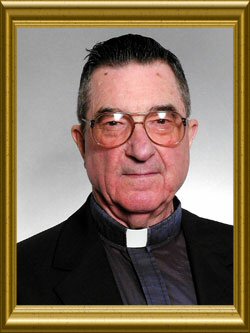
Another tribute I wrote for the Astrologers’ Memorial was for Laurence L. Cassidy, Ph.D., S.J.  A practicing astrologer, he was a Jesuit for 57 years and a Catholic priest for 45.  He had a classical background and was knowledgeable of Church history, yet he never felt a conflict between his religious and astrological beliefs.  I knew him as a long-time friend, student and colleague of Al H. Morrison, and remember a modest and soft-spoken man with a strong intellect.  As one of the notable astrologers I met when Uranus conjoined my Sun, his work influenced my thinking.

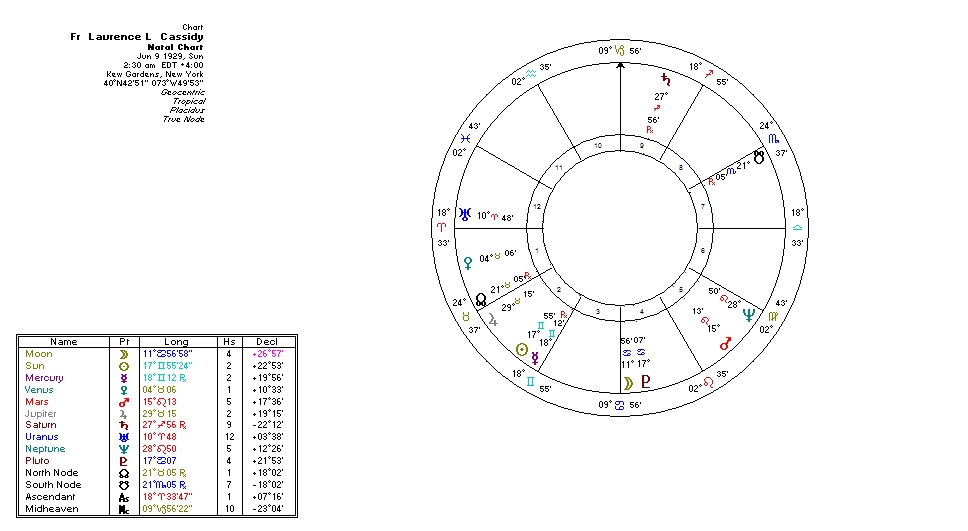
A Gemini with a Cancer Moon and Aries rising, Cassidy was probably born in 1929, but I haven’t confirmed his birth date.  He died on June 29, 2006 at the age of 77.  Fr. Cassidy taught philosophy at St. Peter’s College in New Jersey beginning in 1969 and served as chairman of the department for a time.  The New York Times  covered his metaphysical class in 1972 as “Occult Interests Jersey City Priest.”  His dissertation was on Nicholas Cusa, a 15th century cardinal, who was also interested in astrology, alchemy and the occult.  For Cassidy, he was simply “a learned medieval man.”  His class, “Magic, Mysticism and Metaphysics,” open to 90 students, was often over-booked.  He said, “I like to return to the time when the truth was pursued in all aspects of human experience.  This has been abandoned over the last few centuries with adoption of Aristotle’s view that only that is true that can be proven through our senses.”

The Jersey City Journal also reported on his Rotary Club lunchtime address on Russian psychic experiments to a somewhat skeptical group in February of 1972.  Fr. Cassidy shared that occult and metaphysical topics are part of “the tradition of wisdom” and did not conflict with his other beliefs:  “Whatever happens to man is a reflection of the universe, which is created by God.”

He wrote two books on the transcendental philosophy of St. Thomas Aquinas and was the author of The Thinking Self (1992), a text of Socratic dialogues that he used in the classroom.  (He’d probably be dismayed to see second-hand copies currently selling for $50 and up.)

Cassidy was a contributor to CEO TIMES, Kosmos and other astrological publications.  His popular article, “The Believing Christian as a Dedicated Astrologer” (1978) was reprinted many times.  In it, he maintains that astrology and Christianity are compatible as long as we believe in free will, and says, “I have taught some astrology here at St. Peter’s College and no one has ventured to suggest that I am putting any soul in peril for so doing.  Of course, most think my mind has become enfeebled, but that that is another story… We really are a free community of scholars.”  His article, “Old Astrology and the New Catechism” was originally published in Realtà, the Irish Astrological Association journal, in 1994.  Fr. Cassidy’s writing is lucid, rigorous and uplifting and we’re fortunate to be able to find copies of it online.

Cassidy spoke for the Irish Astrological Association and addressed various conferences and groups in the U.S.  Colleagues and students at St. Peter’s fondly recalled his sermons at their chapel on Sundays, his dedication to “the good and the true,” his love of teaching and his keen interest in his students and their families.

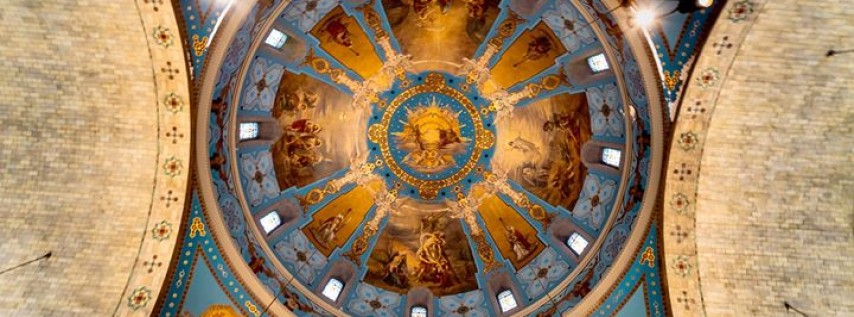
His letter to the editors of National Jesuit News is reprinted in Crisis online and takes an impassioned stance against pacifism in the face of nuclear war.   Below is some artwork from St. Aedan’s Church, now managed by St. Peters’, which resembles a horoscope wheel. 

Birthday Twin Tragedy

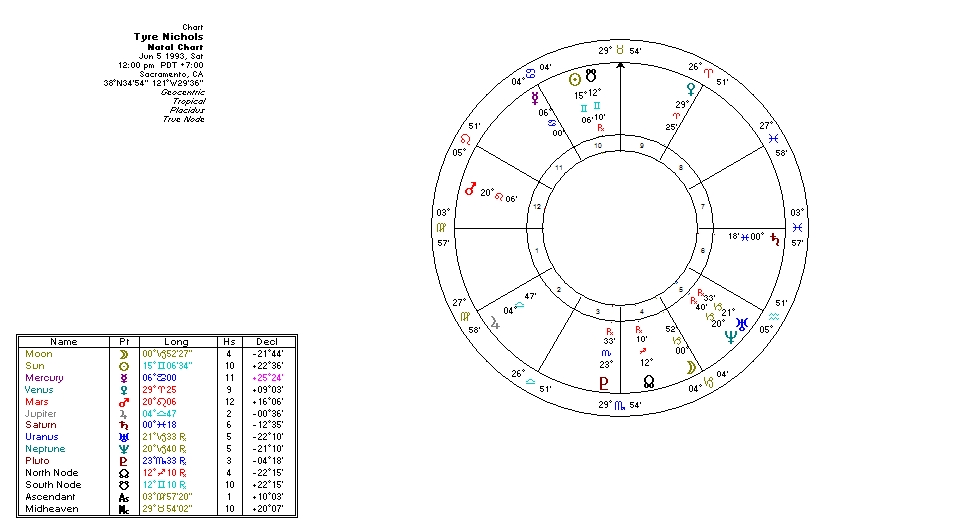
Tyre Nichols and Breonna Taylor are birthday twins – an astounding astrological fact.  They were both born on June 5, 1993, Tyre in Sacramento CA and Breonna in Grand Rapids, MI.  We don’t have birth times for either of these young people, but we can gain some insights from their noon charts.

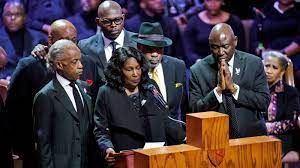
Tyre’s mother, RowVaughn Wells said at his funeral that, “my son was sent here on an assignment from God…”  With this unique synchronicity, I think we have to agree. 

The two were born a day after a total lunar eclipse, sometimes referred to as a “Blood Moon” since the Moon appears reddish in color.  Many people were born near this date, so it certainly doesn’t imply violent outcomes for all.  But the symbolism in these cases is chilling.

Eclipses can make for eventful lives.  Lunar eclipses are full Moon charts that may bring things to light.  The lives and deaths of Breonna and Tyre both highlighted irresponsible and abusive law enforcement practices.

The Sun in Gemini conjoined the South Node, and Mercury in Cancer was Out of Bounds in declination.  Mercury also very closely conjoins the U.S. Jupiter – symbol of justice and the law.  So we can see why their legacy has made them messengers and teachers of important lessons for the U.S.

The most notable thing about the charts to me is how normal they seem.  There’s a Moon-Venus-Mars grand trine and many flowing aspects.  I don’t believe either had essential problems with authority figures, since Saturn is very well aspected.  There’s also an openness of expression in the Sun-Mercury-Jupiter T-square.

Mars in Leo gives courage and a love of life.  But its inconjunct aspects to the generational Uranus-Neptune conjunction might show the forces outside of their own control that overtook them.  And while Mars square Pluto in Scorpio gives perseverance, focus and self-sufficiency, this aspect might point to the tragic violence that they both encountered.  We’d need full horoscopes to say more.

Breonna’s mom reveals that Breonna and Tyre shared the same birthday.

Marcia Moore, Mars and Uranus

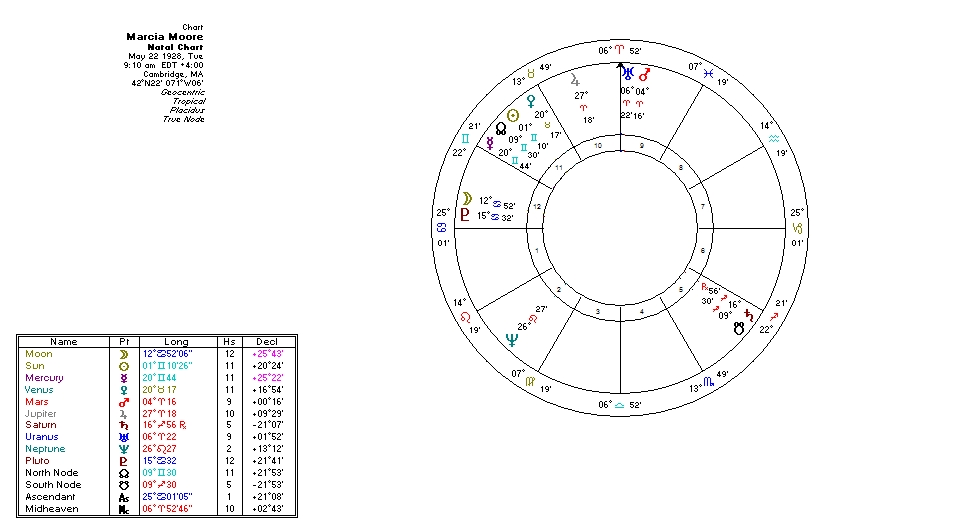
Sometimes a planetary pattern is so prominent that it dominates the chart and has an enormous influence on a person’s life.  Yoga teacher and astrologer Marcia Moore’s horoscope is a good example.  Her Mars closely conjunct Uranus on the Midheaven explains her celebrity, attraction to New Age topics, multiple marriages and even her tragic death.  A new biography, Dematerialized, reveals much about her life and claims to have solved the mystery behind her sudden disappearance in 1979.

The 10th house relates to reputation and position in life, our status or standing.  This may indicate career, fame or notoriety, parents and even marriage (I’ve often seen significant life developments like the birth of children, marriage or divorce when the 10th house is activated).  Marcia Moore had her Mars, Uranus and MC in the sign of Aries, a dynamic and powerful combination that brings out the forcefulness of the planets and also suggests changing fortunes and the potential for controversy.

As second husband Louis S. Acker later said of Mars conjunct Uranus in The Astrologer’s Handbook, the combination can be challenging and may include:

“… impulsiveness and precipitate action… The natives cannot bear a dull life and constantly seek excitement through danger and unusual action.  Courage and decisiveness are prominent, but unless factors in the horoscope indicate otherwise, prudence is lacking.”

Many of these statements could be said about Marcia Moore.  She also had a charismatic personality, attracted attention, and brought innovative ideas to many lives as she rode the New Age wave of the ‘60s and ‘70s.  Since the 4th-10th house axis also represents the home and parents, she came from an unusually prominent family.  Her father was a successful hotel magnate, and Marcia was supported by trust funds, giving her great independence.  Moore’s father was also keenly interested in Theosophy and astrology and donated millions to support the work of Alice Bailey and others.

With the Sun in Gemini sextile Mars and Uranus, Moore had quite an eventful life.  She was led by intellectual and inspirational, rather than practical or realistic goals.  Each of her four husbands shared her interest in astrology or metaphysical subjects, and she married again each time shortly after her divorces were final.  Marcia moved to India for a year with her family in 1955 and studied languages and yoga, never staying in one place for very long.  After they returned to the U.S. she studied yoga intensively with Swami Vishnudevananda in the summer of 1960 near Montreal and returned to Concord, Massachusetts to teach yoga.

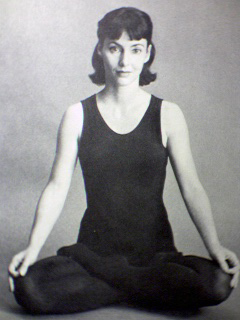
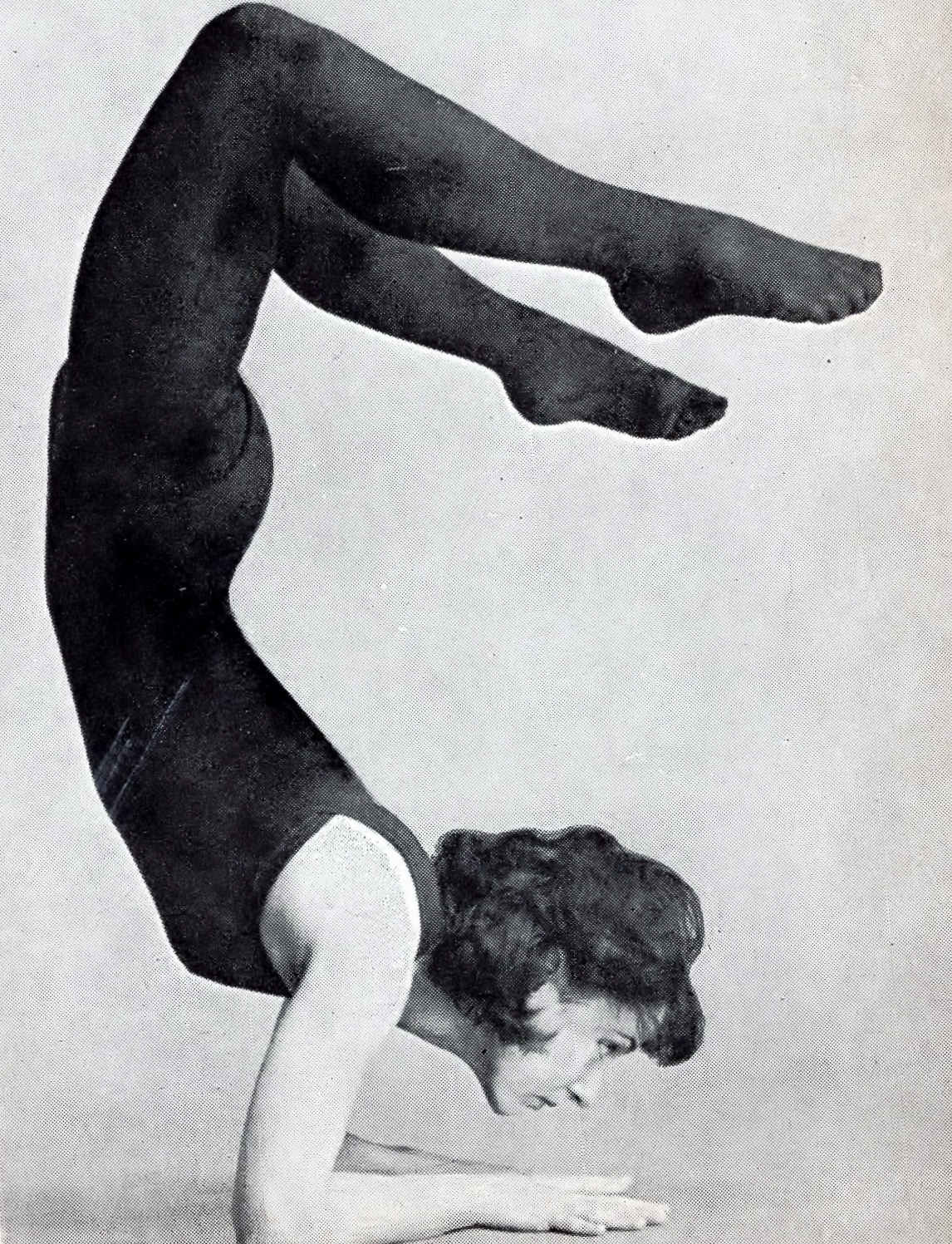
Marcia became somewhat famous after she was featured in Jess Stearn’s best-selling 1965 book, Yoga, Youth and Reincarnation.  Stearn recounted his experiences studying yoga with Moore, and featured photos of her perfectly executing many difficult yoga poses.

Marcia learned more about astrology after her short-lived marriage to Louis S. Acker, who was 12 years younger and still in college when they married.  Moore went on to write several basic yoga and astrology books with third husband Mark Douglas.  (Most are out of print as they were self-published, but some can be found second-hand or online as PDFs.)

When she left Douglas, Moore landed in Ojai, California.  She continued teaching yoga and began lecturing on astrology and past-life regression, which she’d been practicing.  Youthful and communicative, she traveled widely to speak with local groups and appeared in television interviews.  Her 1976 book Hypersentience recounted her experiences regressing herself and others.

Marcia married for the fourth time at 50 after meeting Dr. Howard Alltounian, an anesthesiologist, at one of her lectures in Washington state.  The couple quickly began collaborating on a book about Moore’s transcendental experiences using the anesthetic drug ketamine, a controlled substance that the doctor could obtain.  Marcia’s letters from the time express her attraction to the Uranian controversy that the project might generate, but the regularly injected doses of ketamine seemed to undermine her physical and emotional health.

A little over a year after their marriage, Howard returned from the movies one night to find Marcia missing.  Her life had ended with typical Mars-Uranus suddenness and perhaps even violence as well.  Two years later, a portion of her skull was found on overgrown private property and later identified from dental records.

No one has ever solved the mystery, but over 40 years after Moore’s death, the authors of Dematerialized piece together a theory.  Their focus is on the “true crime” angle, but they have also collected a wealth of information that illuminates Marcia Moore’s horoscope.

I hope to write a review of Dematerialized in a future post.

Marcia Moore’ birth data is rated A on Astrodatabank, Lois Rodden quoted Moore, who was her birthday twin.

Yoga, Youth and Reincarnation has gone through numerous printings in the 50 years since it was published, and is still available.

Moore’s Hypersentience is also available second-hand.

About my reviews and links.

P.L. Travers Consults Johndro

Mary Poppins’ creator P.L. Travers had been successful in her career, but at age 40, when she was offered a set of twins to adopt, she felt she could only take one.  Should she do it?  And which child to take?  Who could answer this kind of question but an astrologer?  She consulted L. Edward Johndro half a world away and listened to his advice.

The Poppins books contain many magical elements, and these grew out of Travers’ world view.  She had worked as a Shakespearean actress and newspaper columnist in her native Australia before moving to London in 1924 at the age of 25.  There she met George William Russell (also known as AE), the editor of the Irish Statesman.  Through him, Travers explored Celtic mythology and Eastern religions, and met Yeats and other metaphysical thinkers.  She became interested in Theosophy and followed Krishnamurti, studied with Jung in Switzerland and was even a disciple of Gurdjieff, whose consciousness-raising program included fasting, labor and dances.  Travers loved Romantic poet William Blake, another original thinker who was also interested in astrology.

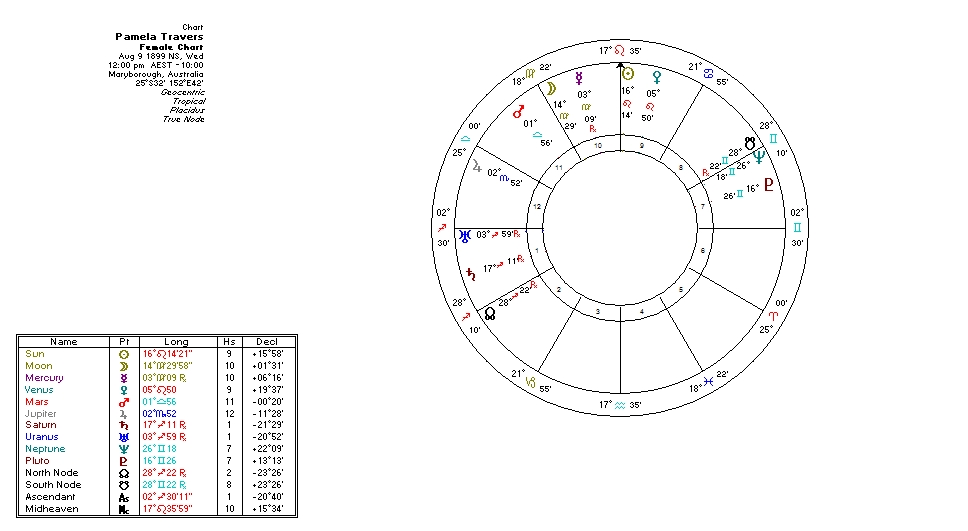
Uranus conjoined her Ascendant in Sagittarius, and Pamela was a seeker who identified with esoteric subjects.  Uranus trining her Venus in Leo in the 9th shows her love of writing and study, as well as her phenomenal worldwide success.  The Sun in Leo conjunct the Midheaven and Mercury in Virgo in the 10th house, both dignified, clearly signify her many achievements.  She had a formidable horoscope with an equally notable life and personality.

Despite her prominent Leo planets, Ascendant-ruler Jupiter is placed in the 12th house in Scorpio, turning her inward and attracting her to imaginative work and occult studies.  Her biographer, Valerie Lawson, shared that she had a reserved personality and “valued anonymity.”

Her early life had been difficult.  Saturn was rising and part of a tight T-square with her Moon in Virgo conjunct the 11th house cusp and Pluto in the 7th, showing a notable disruption and maybe even questions of survival.  Saturn traditionally rules the 4th house relating to home and family, and its modern ruler Uranus also comes to her 1st and  squares Mercury.  Travers’ father died when she was seven and she was raised by an older aunt.  While her mother had some family money, her uncle lost much of it through mismanagement.

Travers was concerned with finances as an adult, and Saturn-Pluto is quite security-oriented, especially with the T-square involving the Moon in Virgo.  She must have had anxieties but was probably a disciplined writer.  Her son’s oldest brother Joseph Hone, writing critically, said that she was “steely, self-centered and very controlling,” and added that she was “a contrary, divided, hypochondriac of ambiguous sexuality.”  The Moon in Virgo also shows her attraction to the discipline of Gurdjieff’s “work,” and Hone added that Guardjieff advised her to take an enema a day!

A friend was the grandfather of six children abandoned by their parents.  Pamela travelled to Ireland to visit the twins and consider adoption in October of 1939.  Camillus was better-looking but crying, and she wasn’t sure.

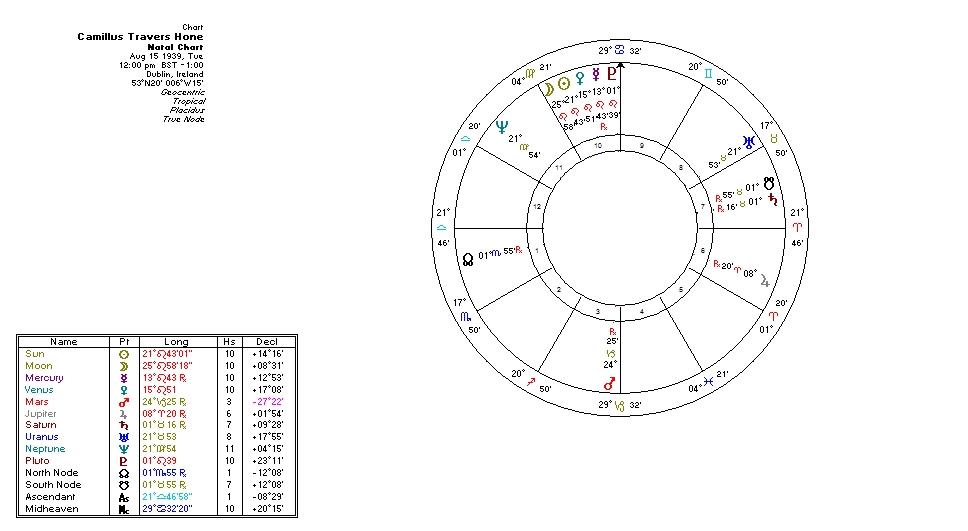
Travers’ mentor AE was later an adviser to Franklin D. Roosevelt, whose one-term Vice President Henry Agard Wallace also worked with L. Edward Johndro.  So AE may have recommended Johndro.  Pamela wrote to the astrologer, who did both charts to help her decide.  (She must have had their times of birth, which we do not.)  Johndro soon wrote back to recommend Camillus, saying that “All in all it would be a rare thing to find better cross rays between a child and its OWN mother.  So I would say, by all means, ADOPT HIM.”

Camillus was also a Leo, with his Sun conjunct Travers’ own.  Not only that, his Sun, Mercury, Venus and Pluto all in Leo fell at the top of his adoptive mother’s chart.  His Moon, whether in Leo or Virgo, did the same, so there was much common ground.  And they unfortunately also shared hard Saturn-Pluto aspects.  Camillus’ Saturn was almost exactly square Pluto, and Saturn also conjoined his South Node.  He had learned the lessons of survival in infancy, and was underweight, underdeveloped and in and out of hospitals for a few months after Travers brought him home.

Pamela was born on a first quarter Moon, and Camillus on a new Moon.  While they had issues (particularly the fact that she hadn’t told him the truth about his birth), they remained on “more or less friendly terms” throughout their lives.  But according to biographer Lawson, Travers gave Mary Poppins a dramatic full Moon at birth!

And while Camillus was fortunate in his adoption, he had drinking problems throughout his life as did his twin Anthony, who he didn’t meet until he was 17.  Anthony died an alcoholic at the age of 65 while Camillus lived six years longer.

Pamela became wealthy in the 1960s from the Mary Poppins Disney film.  Beginning in 1976, she was a consulting editor and contributor to the magazine Parabola, which addressed mythology.  She left over ₤2 million in trust for her son and grandchildren when she died in 1996 at the age of 96.

Mercury was one of her most notable planets and her fame came through her writing.  In 2018, a crater on Mercury was named for her!

Frances McEvoy obtained Travers’ birth data from her according to Astrodatabank.  Though it may be rounded-off to noon, her life does seem to resonate with this time.

Emma Thompson convincingly portrayed a curmudgeonly Saturn-rising Travers in Saving Mr. Banks.

Valerie Lawson did excellent research for her biography of Travers, Mary Poppins, She Wrote.

About my Amazon links.

Wise Men

Worldly leaders work their way up to positions of authority, are elected, inherit their jobs or sometimes seize power. Spiritual masters are different, since their authority reflects their inner lives and not the material plane. They, too, may work their way up in an organized group, or they may simply be found. Their stories of recognition, sometimes at an early age, may be recorded for history.

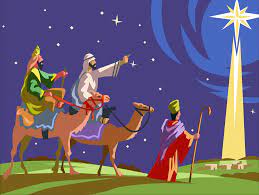
Much has been written about the Christmas star, with astronomers, astrologers and historians weighing-in on what, exactly, it was. It’s been seen as a comet, a Jupiter-Saturn conjunction and a supernova. Astrologer Courtney Roberts believes that the Magi (wise men or even astrologers in some New Testament translations) who visited Jesus from the east were in fact Persian Zoroastrian priests, known for both astrology and dream interpretation. This seems to be a more important point.


Mathew in Chapter 2 tells us that the star was a sign leading the Magi to the baby Jesus. When they inquired where the child could be found, the Roman ruler Herod hoped to enlist them to locate the baby for him (learning of the prophecy in Micah 5:2 stating that the child would come from Bethlehem). But the Magi were warned in a dream and went straight home after recognizing and presenting gifts to Jesus, who may have been two years old.

Micah also says that the promised Israeli ruler’s “goings forth have been from of old, from everlasting,” which might also suggest reincarnation. The Magi’s gifts of gold – for royalty but also representing alchemical perfection; frankincense – an incense used in temple rituals that represents spirituality; and myrrh – used in burial rituals, which might allude to the reappearance of the spirit on earth.

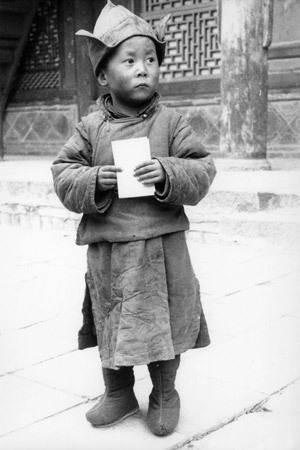
We have more detailed information on the discovery and recognition of the 14th Dalai Lama, the great guru of compassion, believed to be the reincarnation of his predecessor. Once again, prophecy and signs led wise men to find him. The head of the 13th Dalai Lama, after his death in 1935, was found facing east. It was the Tibetan Regent’s role to find the successor, and he saw a clear vision in the sacred Tibetan lake of a monastery and house. Following these and other signs, search parties of high lamas and dignitaries looked for the place described.

When found, the party disguised their roles, but the two-year-old boy of the household recognized the rosary worn by the group’s leader and named him. Other recognition tests followed; various items were presented to the boy, and he was able to identify the ones he had owned in his previous incarnation. His identity was confirmed and the 14th Dalai Lama was officially enthroned in 1940.

Though these stories are separated by over 2,000 years and 3,000 miles, they describe similar spiritual practices of discovery and verification. Both appear to reflect trust in traditional practices that include omens and prophecies, and were considered important enough to be captured for posterity.

This brief biography of the Dalai Lama includes the story of his identification.

Austrian mountaineer Heinrich Harrer also wrote about the discovery of the Dalai Lama in his book, Seven Years in Tibet.

How to be Compassionate is a wonderful and accessible book from the Dalai Lama.

Ian Stevenson Was a well-known reincarnation researcher; he wrote about young children who remembered previous lifetimes in 20 Cases Suggestive of Reincarnation and Children who Remember Previous Lives.

About my links.