
Category Archives: astrology history

Evangeline Adams and Pluto

Astrologer Evangeline Adams was often ahead of her time. An Aquarian herself, she spoke about the Age of Aquarius in her public lectures in 1930. In an interview with the Palm Beach Daily News on March 28, 1930, she also talked a little bit about the planet Pluto. Pluto’s discovery had been announced only two weeks before! Adams correctly identified Pluto as a higher octave of Mars, as we still consider it today.

The new planet recently discovered represents martial force on a higher plane, which will usher in new inventions so close to the intelligence of man that they will save instead of destroy him. We are entering into a new phase of consciousness where Reason will prevail. Always at such times a new planet is discovered.

Before the discovery of the modern planets, Mars ruled both Aries and Scorpio. Saturn ruled Capricorn and Aquarius, and Jupiter ruled Sagittarius and Pisces. When Uranus was discovered in the 18th century, astrologers soon gave it rulership over Aquarius. When Neptune was discovered in the 19th century, astrologers realized its affinity for Pisces. Pluto, the god of the underworld, had an obvious correlation with the sign of Scorpio, and thus also related to Mars. Any astrologer could see the connection, but Evangeline seems to have been the first to discuss it publicly.

Adams appears to link Pluto somewhat with the dawn of the Age of Aquarius. Certainly atomic power and the nuclear sciences would soon be developed. Also ruled by Pluto are X-rays, synthetic chemistry, plastics, genetic engineering, psychology and the mass media, all of which had increasing interest at the time.

In hindsight, Adams’ thought that these could “save instead of destroy” is of course debatable. But she was always optimistic.
Evangeline Adams’ Birth Date

After researching Evangeline Adams’ life for many years, I was convinced of her birth data: February 8, 1868 at 8:30 AM in Jersey City, New Jersey  No alternate information had ever been presented during her lifetime or in the decades following.  In addition, an Adams family genealogy book published in 1898 confirmed her birth date.  In 1900 Census records, Evangeline tells us she was born in February of 1868.  These were some of the earliest records I found in the late 1990s and they were consistent.  At the time I was never able to find Evangeline’s original birth record.

Later records, unfortunately, present different information.  Adams and her husband fudged their ages on their marriage records, as their 20+ age difference was unusual.  The 1910 and 1920 Census records gave differing ages, but may have been completed by assistants and not Adams herself.  Lois Rodden published all of this information in her Astrodatabank newsletter.  However she tended to simply present the facts and drew no conclusions.

 Data collector Ed Steinbrecher discovered a 1933 issue of Alan Leo’s Modern Astrology magazine in which Catherine Thompson, one of Adams’ teachers, suggested she was ten years older than she claimed, but gave no details.  However Thompson and Adams seemed to have something of a combative relationship, and this always struck me as a snarky “dig.”  Hymenaeus Beta, who published some of Adams’ works as The General Principles of Astrology under Aleister Crowley’s name, was also an advocate for an alternate birth year.  Although he did fantastic research for that book, I still could not agree with him. 

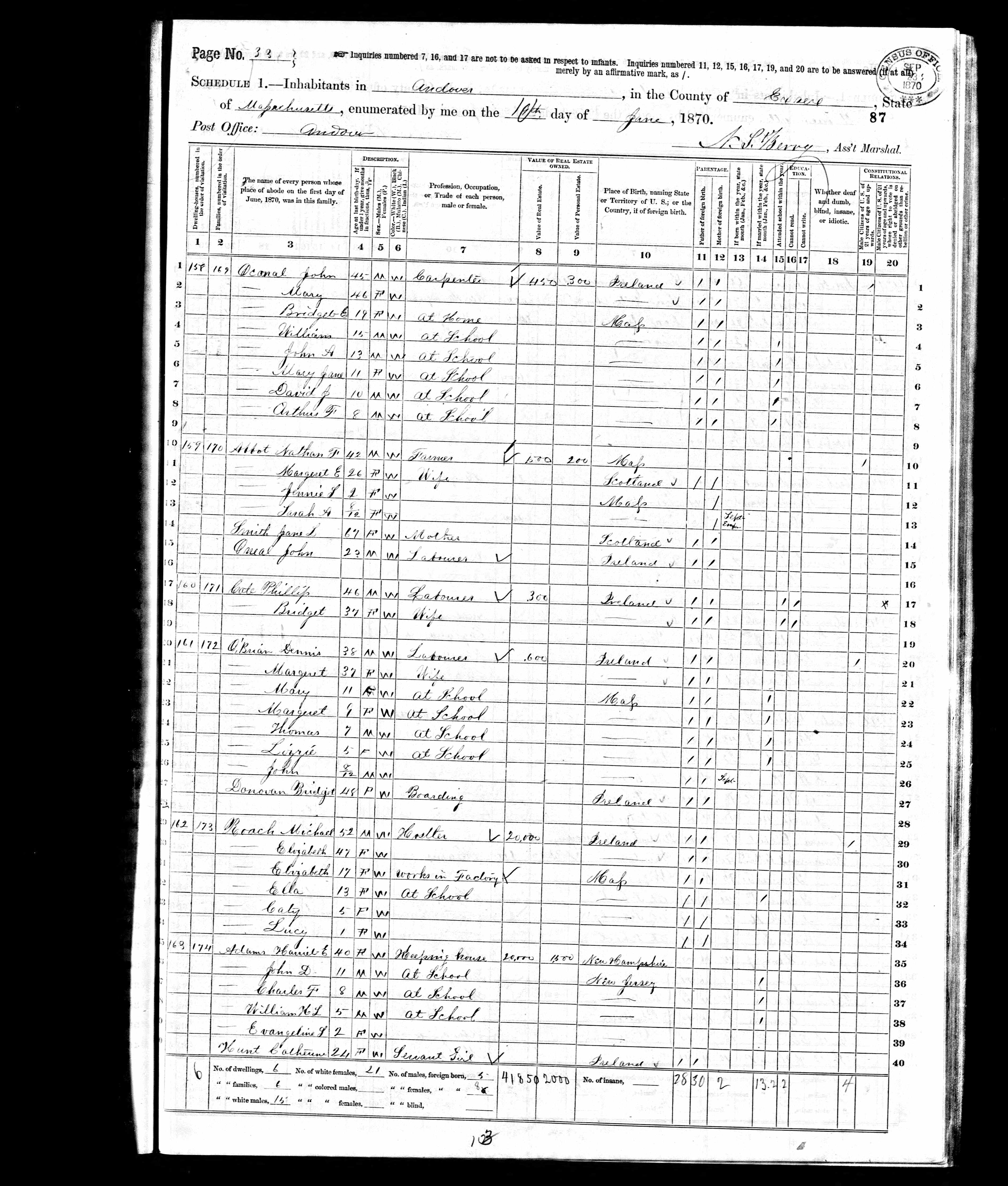
Evangeline Adams, 1870Researching U.S. Census records in the 1990s was a time-consuming process.  I found the 20th century records for Adams at the National Archives on Varick Street in Manhattan, but did not locate earlier ones at that time.  Now that so much genealogy information is available on the Internet, it becomes easier.  The 1870 Census shows Evangeline at age 2 in Andover, Massachusetts, just where she said she was (line 39).

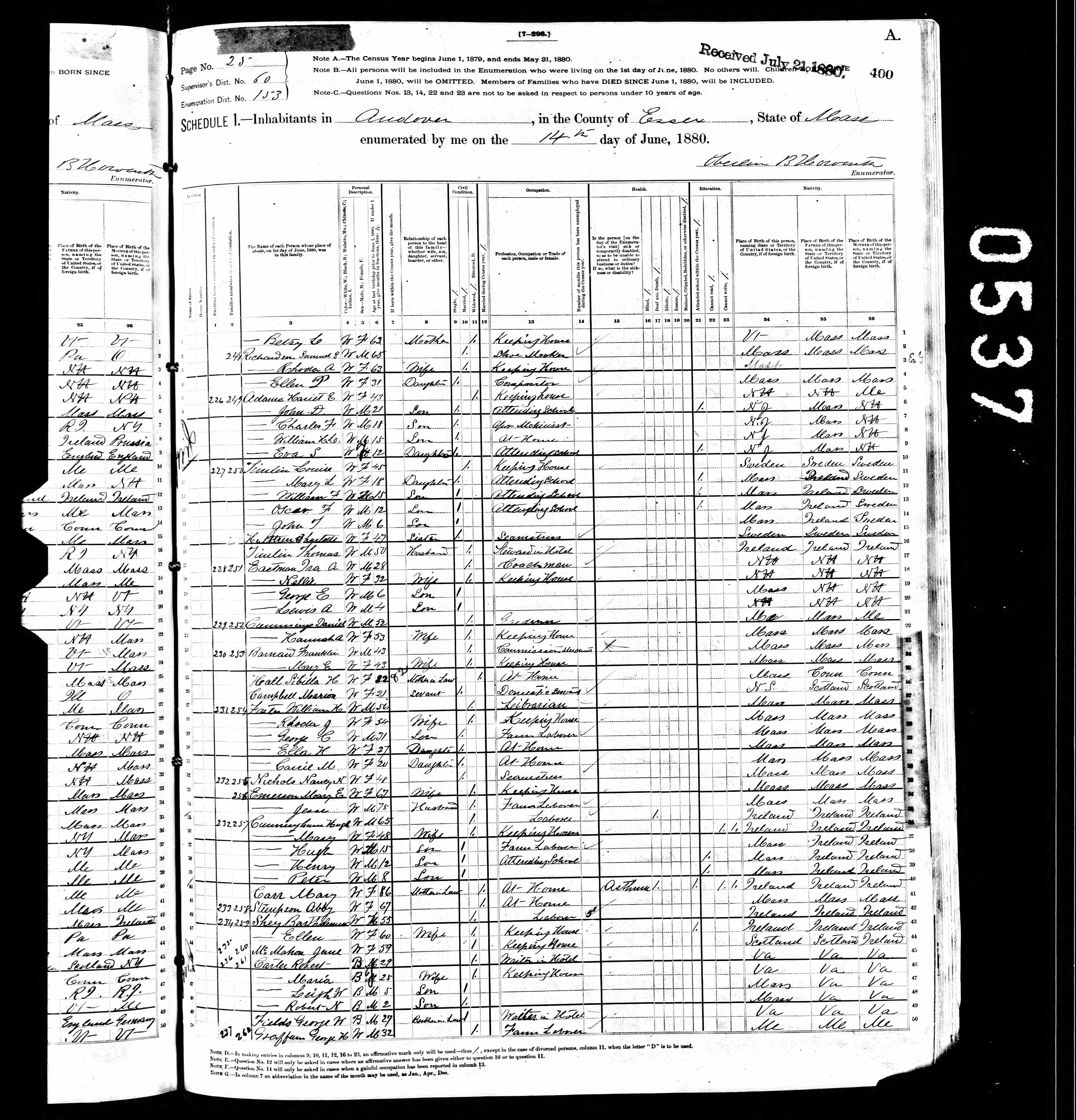
In 1880 Census records, Evangeline is 12 (line 9).  In both decades, her three brothers also appear along with their correct ages.  So I felt that these lent greater authenticity to Evangeline’s birth year of 1868. Evangeline Adams in 1880

After working in genealogy for a number of years, I later realized that birth records in the U.S. and other countries may be located in different places.  I had only requested birth records from the Jersey City, New Jersey archives.  When I turned to the State of New Jersey, I finally found Evangeline’s birth record!

The baby wasn’t named yet when the birth was recorded.  But her father’s name, George Adams, is clear.  George Adams was a common name though.  The birth record also provides a street address where the family lived.  Evangeline tells us in her autobiography that her father died before she was two years old.  And sure enough, that address is repeated for George Adams in his obituary from that date.  E Adams birth record

As is often the case with research, if we continue looking, we can find more.

Traditional vs. Modern

Many astrologers today blend psychological with traditional astrology, making little distinction between the two philosophies. Many of the differences are historical.

When I first studied with Zoltan Mason (who was born in 1906) in the 1980s, he’d say things like, “Wherever you put Saturn you get some kind of difficulty.” Then I’d read something like Liz Greene’s 1976 book on Saturn and she says, “Saturn fosters the exhilaration of psychological freedom.” A bit confusing! But the difference shows the change in astrology over the 20th century. Mason studied works written in Latin by astrologers like Jean Baptiste Morin (17th century), and Greene had a contemporary point of view.

Over the centuries, astrology often adapted itself to prevailing trends. Alan Leo practiced a more predictive type of astrology until his conviction for fortune-telling in 1917, when he decided for legal reasons to delete all predictive references from his work (he died trying). Evangeline Adams’ work from the same time shows a very predictive bent. But her books from the late 20s and early 30s have a more psychological tone as she tried to reach a wider audience. As time went on, more astrology books described personal development and character, paralleling the rise of psychology.

Bob Zoller has always said that the concept of “evolution” is a very modern idea. Scientists today typically use linear thinking: we at the contemporary end of the line of time are always “better” than those before us, “more advanced” and knowledgeable. And astrology is a remnant of the past.

If we think of how tough it is to understand a Shakespeare play written about 400 years ago, how much more difficult is it to understand Plato, writing almost 2,500 years ago? It’s a stretch, and that’s in translation, too, putting it another step away from us. The first Greek horoscope is from around the time of Plato, but the idea of astrology is at least 2,000 years older and maybe even more.

Modern astrology is an adaptation to a contemporary perspective. Traditional astrology comes from a completely different paradigm, which is not understood very easily today. Whatever appeals to you, use it!

Welcome!

Hello! I’m Karen Christino, an astrologer and writer. I became addicted to astrology when I was 15 and I’m still hooked. And while I’ve written humorous essays and self-help pieces, what I mostly end up writing about is astrology. I find astrology endlessly fascinating since it can illuminate any facet of our lives. That’s why I love doing horoscope interpretations and personal forecasts for the future. We can anticipate what’s next in our lives.

But to look forward we also need to look back and understand past cycles and our multifaceted astrological tradition. So I’ve written books about the famous astrologer Evangeline Adams and edited a book of the incorrigible Al H. Morrison’s work, and done hundreds of articles about astrology and astrological techniques for astrology journals.

I’ve had a lot of fun with astrology, too, writing horoscope columns for such terrific magazines as Glamour, Cosmopolitan and Life & Style Weekly, along with features and forecasts for numerous other mainstream publications.

I believe that astrology can help us better understand ourselves, live our lives more fully, and begin to see the workings of the Cosmos. That’s why I tend to be something of a traditionalist. I see the psychological side of astrology, too, but I feel that astrology can help us more when we take the time to do a thorough study of an issue and make a definitive judgment. It can be done – it just takes time, and effort, and the acceptance that there are answers to our questions out there if we’ll look for them.

I hope you enjoy the thoughts that that I’ve collected on these pages!


Karen Christino is a participant in the Amazon Services LLC Associates program, an affiliate advertising program designed to provide a means for sites to earn advertising fees by advertising and linking to Amazon.com